
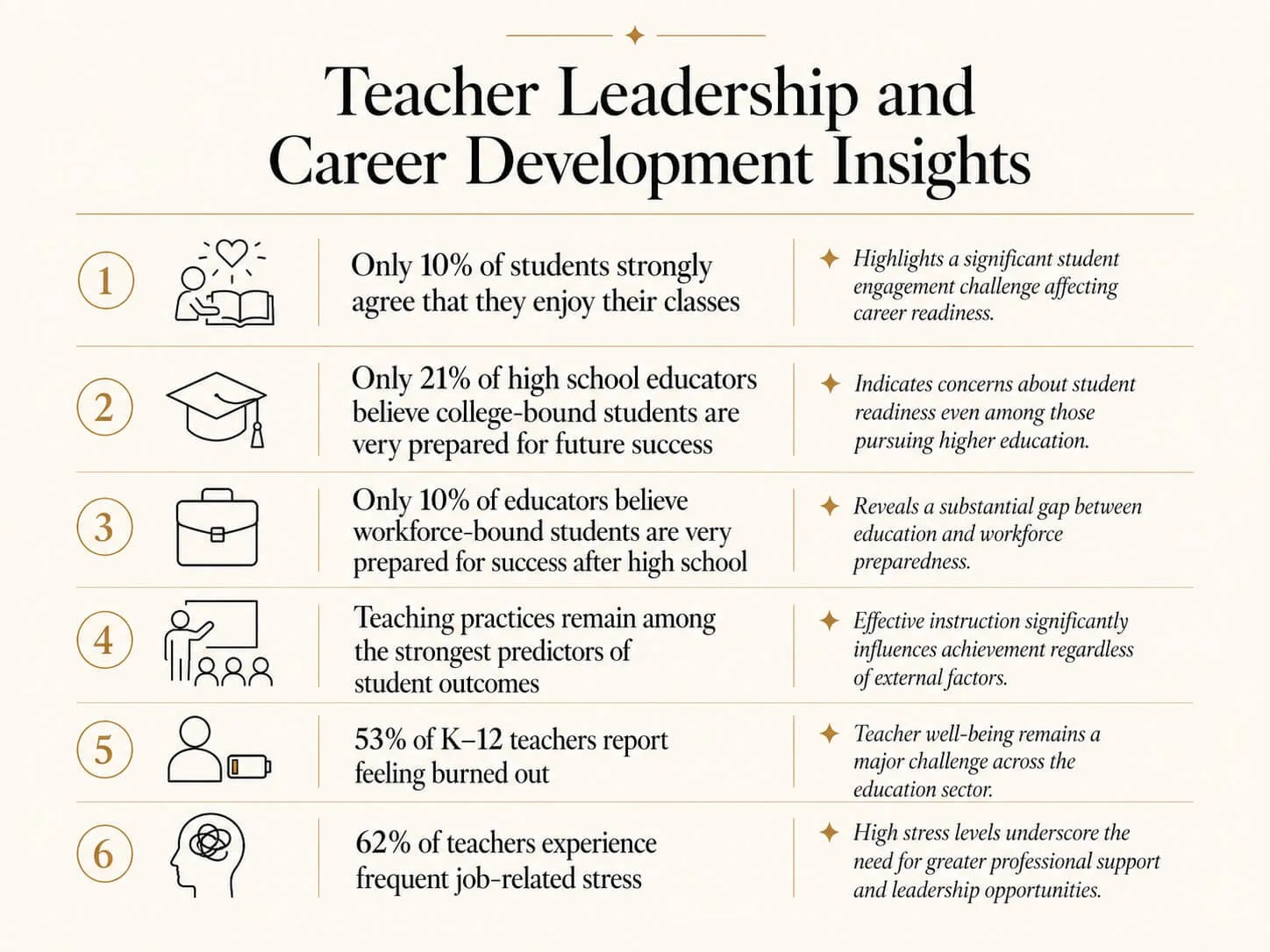
Today's classrooms are where future careers begin to take shape. However, only 10% of students say they actively enjoy their day-to-day learning experience. That number, from a recent study of K-12 learners, says something striking about the disconnect between what schools deliver and what students need to build real career readiness.
Teachers sit at the center of closing that gap. When they move beyond content delivery and take on roles as career coaches, curriculum innovators, and institutional leaders, they do not just improve test scores. They reshape the entire culture of how students think about their futures.
QUICK ANSWER
Dedicated teachers drive systemic change by connecting classroom learning to real-world skills, future careers and long-term student outcomes. When teachers act as curriculum designers, mentors and school leaders, they can improve student engagement, support career readiness and influence change beyond their own classroom.
Teachers can support career development by:
Connecting lessons to real workplace skills
Helping students understand how subjects link to future careers
Building confidence, communication and problem-solving into classroom activities
Redesigning curriculum around practical, career-connected learning
Mentoring students and colleagues
Using student engagement data to improve teaching approaches
Taking on leadership roles that influence school-wide change
Continuing their own professional development so they can lead with confidence
👉 If you want a structured way to think about future direction, the Career Development Plan Template helps you review goals, identify skill gaps and build a clearer path towards long-term career growth.
Teachers as Career Development Architects
Every individual profession has a learning curve. As eras advance, it is our responsibility to constantly learn and attain global education so that we deliver our best to students. It is time for teachers to stop treating career development as a guidance office function. They must start treating it as a classroom responsibility.
There are many sources on the internet that can transform a teacher’s role as an education provider. They can help attain a world-class degree in education innovation without a career break. An online EdD in curriculum and instruction can help educators develop the expertise needed to design impactful and engaging learning environments.
American International College notes that the program equips learners to design district-wide curriculum frameworks and lead initiatives that align daily instruction with long-term student outcomes. This is not supplemental professional development. It is a structural change in how teachers understand their role within a larger institution.
The importance of investing in educational leadership is hard to ignore. According to a Walton Family Foundation survey, only about 1 in 5 high school educators believe students heading to college are well prepared for what comes next.
Confidence is even lower for students entering the workforce straight after high school, with only 10% considered highly prepared.
The results point to a challenge that educators themselves readily recognise. The question is who has the tools and the institutional authority to address it systematically rather than one classroom at a time.
ACTIONABLE TIP
Teachers do not need to turn every lesson into careers advice. The stronger approach is to embed career relevance naturally.
For example:
A writing task can develop workplace communication
A group project can build collaboration and leadership
A maths problem can connect to budgeting, engineering or data analysis
A science lesson can link to healthcare, climate, technology or research
A presentation can develop confidence and public speaking
This helps students see that career readiness is not a separate subject. It is built through the skills they practise every day.
👉 If you are exploring how career choices are changing, this guide explains how to choose a future-proof career in the AI era, including how to match personal strengths with market demand.
What Systemic Change Actually Looks Like
Systemic change in schools does not happen through individual classroom improvements alone. It happens when one teacher with advanced training influences every teacher in a building. A McKinsey research on global student achievement consistently finds that teaching practices rank among the strongest predictors of student outcomes, separate from household income or school resources.
When a lead educator redesigns curriculum to include career-connected learning, builds mentoring structures for new colleagues, and advocates for policy changes at the district level, the effects travel far beyond a single classroom.
This kind of leadership also matters for the teachers themselves. Teaching continues to be a demanding profession.
The State of the American Teacher survey found that more than 53% of K–12 educators struggle with exhaustion and ongoing workplace pressure, highlighting the challenges they face both inside and outside the classroom.
The teachers least likely to leave the profession are those who feel invested in their school's direction and who hold roles that give them genuine agency.
Advanced credentials in curriculum and instruction create that pathway, turning classroom teachers into institutional change agents rather than isolated practitioners grinding through a 50-hour week with no clear path forward.
ADDITIONAL INSIGHT
Systemic change often begins when good practice becomes shared practice. A single teacher may improve one classroom, but a teacher leader can help improve the wider school.
This might involve mentoring new teachers, sharing career-connected lesson ideas, supporting curriculum planning or helping departments link learning to future pathways.
The most effective change is not usually dramatic. It is consistent, practical and repeated across the school.
ACTIONABLE TIP
A school that wants to strengthen career readiness could start by asking each department to identify:
The workplace skills their subject develops
The industries linked to their subject area
The career pathways students may not know about
The projects or assessments that could become more real-world
The employers, alumni or local organisations that could support learning
This turns career development from a one-off event into a whole-school habit.
Career Development Cannot Happen Without Curriculum Redesign
One of the most underappreciated levers for student career readiness is curriculum design itself. When course content connects to real industries, when assessments ask students to solve actual problems, and when teachers have the expertise to facilitate that kind of learning, students start seeing school as preparation rather than an obligation.
That progress tracks directly with improvements in how engaged students report feeling at school.
The teachers who produce that effect share common traits. They are pedagogically curious. They understand how to sequence learning for long-term skill development. They see themselves as leaders inside the profession. They also tend to hold advanced qualifications that give them structured time to study what research actually says about learning, engagement, and student outcomes.
That depth of preparation shows up in the classroom in ways students can feel.
ADDITIONAL INSIGHT
Curriculum redesign does not mean making lessons less academic. It means helping students understand why academic learning matters.
Students can still study challenging content, but they should also be able to see how that knowledge connects to decisions, problems, industries and opportunities beyond school.
This is especially important for students who do not yet see themselves as “career ready”. A well-designed curriculum can help them build confidence gradually, rather than waiting until the final years of school to think about their future.
ACTIONABLE TIP
When reviewing curriculum, look for opportunities to include:
Real-world case studies
Employer-linked projects
Student reflection on skills developed
Problem-solving tasks based on practical scenarios
Presentations, teamwork and research activities
Links to local labour market needs
This gives students more chances to practise the skills they will need after school.
👉 If students are starting to think about future skills, this guide explains what skills to include in your CV, from communication and leadership to problem-solving and technical strengths.
From the Classroom to the System
The most dedicated teachers eventually outgrow the four walls of their classroom. They write district policy, mentor incoming educators, lead professional learning communities, and advocate for resource allocation that reflects real student needs. This progress is not accidental. It follows deliberate and sustained preparation over time.
Schools that want to improve student career outcomes need more educators who treat career development as a design challenge, not a passive aspiration. That work starts in individual classrooms and ends in institutional transformation. The teachers willing to lead that journey are the ones who choose to keep learning long after they have earned the right to stop.
ACTIONABLE TIP
Teachers who want to influence systemic change can start small by:
Sharing one successful lesson approach with colleagues
Offering to support a curriculum review
Mentoring a newer teacher
Leading a short professional development session
Collecting student feedback on career relevance
Building links with local employers or alumni
Small leadership steps can build confidence and create momentum.
Why Teacher Leadership Matters for Career Readiness
Career readiness is not only about telling students which jobs exist. It is about helping them build the confidence, skills and self-awareness to make informed choices.
Teachers are uniquely placed to do this because they see how students think, learn, struggle and grow over time. When teachers are supported to lead, schools can move career development from occasional advice sessions into the daily learning experience.
This makes career readiness more inclusive, more practical and more connected to the real needs of students.
FAQs
1. How do teachers influence student career development?
Teachers influence career development by connecting classroom learning to real-world skills, industries, and future opportunities. Through career-connected lessons, mentorship, and curriculum design, educators help students understand how academic knowledge applies to college, careers, and lifelong success, improving both engagement and workforce readiness.
2. Why is teacher leadership important for systemic school improvement?
Teacher leadership helps spread effective practices across an entire school. Educators who mentor colleagues, redesign curriculum, and contribute to policy decisions can improve teaching quality, student outcomes, and career readiness at scale. Their influence extends beyond individual classrooms to create lasting institutional change.
3. How can advanced education help teachers become change agents?
Advanced degrees in curriculum and instruction equip teachers with expertise in leadership, learning design, and educational innovation. These skills enable educators to develop career-focused curricula, lead school-wide initiatives, support colleagues, and create systems that better prepare students for future academic and professional success.
How can schools make career development part of everyday teaching?
Schools can make career development part of everyday teaching by linking lessons to real-world skills, industries and future pathways. This can include practical projects, employer examples, student reflection, workplace problem-solving tasks and curriculum planning that shows how subjects connect to life beyond school.
Do teachers need specialist training to support career development?
Teachers can support career development without becoming careers advisers, but professional development can help. Training in curriculum design, student engagement, leadership and career-connected learning gives teachers more confidence to link classroom activity to long-term student outcomes.
Why does student engagement matter for career readiness?
Student engagement matters because students are more likely to build skills and confidence when they understand the purpose of their learning. If students can see how school connects to future opportunities, they may be more motivated to participate, persist and think seriously about their next steps.
Teacher Leadership and Career Development Insights
Dedicated teachers do far more than deliver lessons. They shape the systems, experiences, and opportunities that influence how students prepare for the future. By embracing roles as curriculum designers, mentors, and educational leaders, they help bridge the gap between classroom learning and career readiness.
As schools face growing demands to equip students with real-world skills, investing in teacher leadership and professional growth is no longer optional. It is one of the most effective ways to create lasting institutional change, strengthen student outcomes, and build a workforce prepared for the challenges and opportunities of tomorrow.
Closing Insight
The future of career development in schools will depend heavily on teachers who can connect learning with life beyond the classroom. Students need more than information about careers. They need repeated opportunities to build useful skills, understand their strengths and see how education links to future choices.
That kind of change does not happen through one assembly, one careers week or one guidance session. It happens when dedicated teachers make career readiness part of the culture of learning.
👉 If you are ready to plan your next move or support someone else with theirs, browse our CV templates and job search tools for practical resources that make career planning and applications easier.