Last updated: 17/09/2026
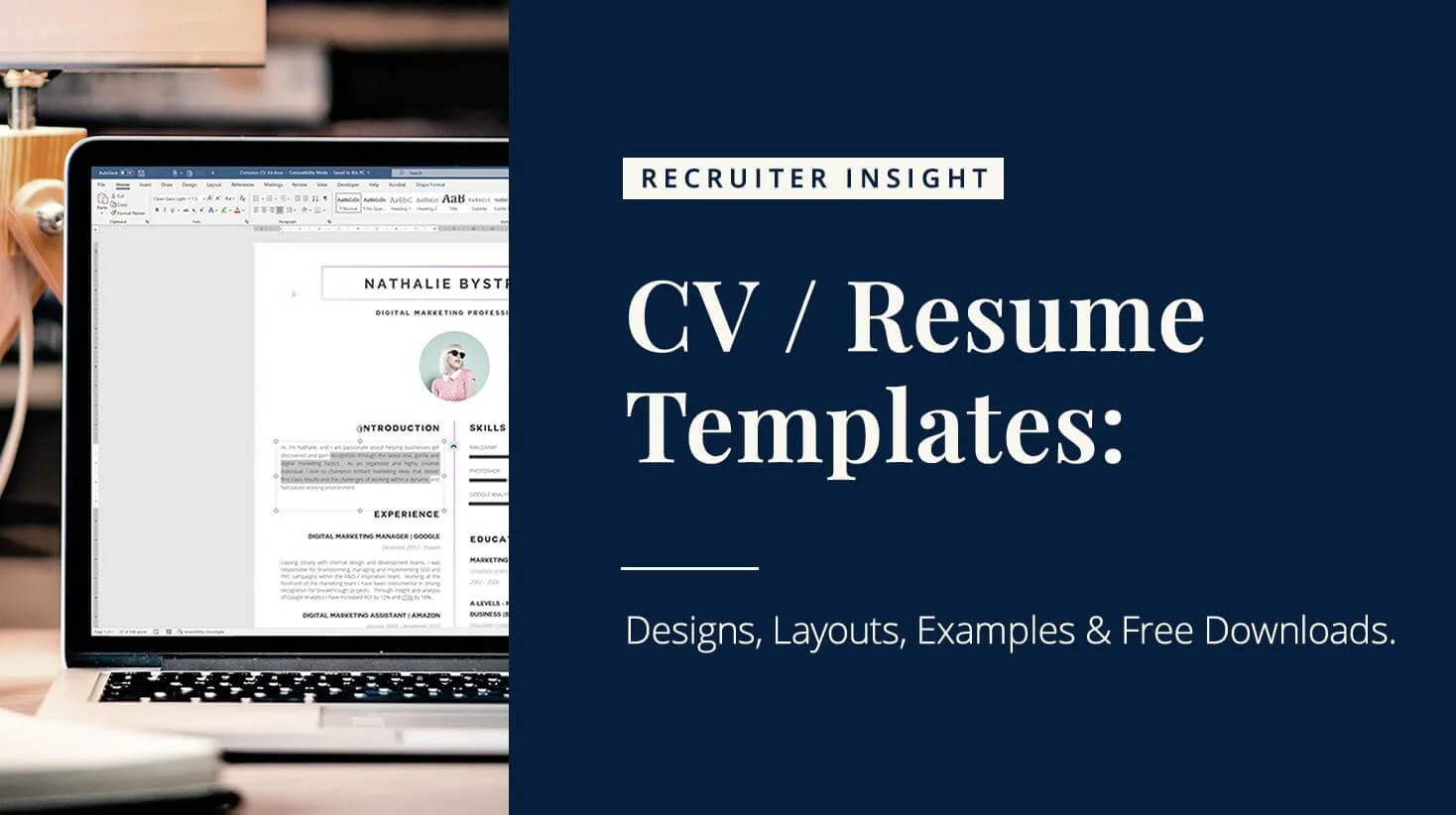
In a competitive job market, having an effective CV is one of the basics if you want to stand out.
Choosing a CV template makes writing your CV easier, but with thousands of designs available, from simple single column layouts to modern two column CVs, creative designs and highly structured professional templates, where do you start?
A good CV template should do three things:
Make your experience easy to understand
Give the most important information the most visual weight
Suit the type of role you're applying for
Everything else is secondary.
In this guide we'll look at the main CV template styles, show examples of where each works best, compare one and two column layouts, cover ATS considerations and help you choose a design that actually suits your career.
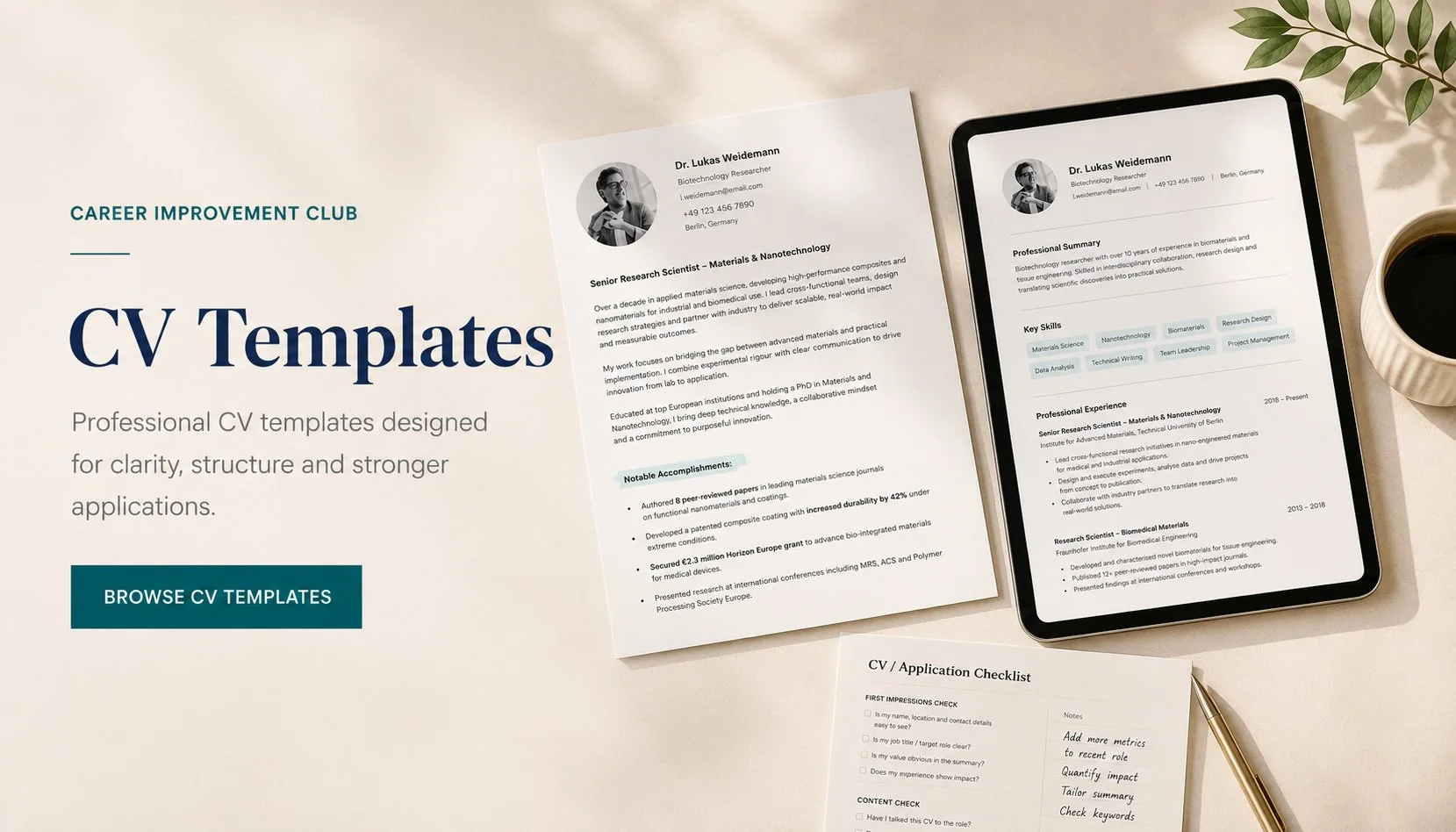
If you'd rather skip straight to the designs, you can browse all our editable CV templates here.
Quick Answer: What Is the Best CV Template?
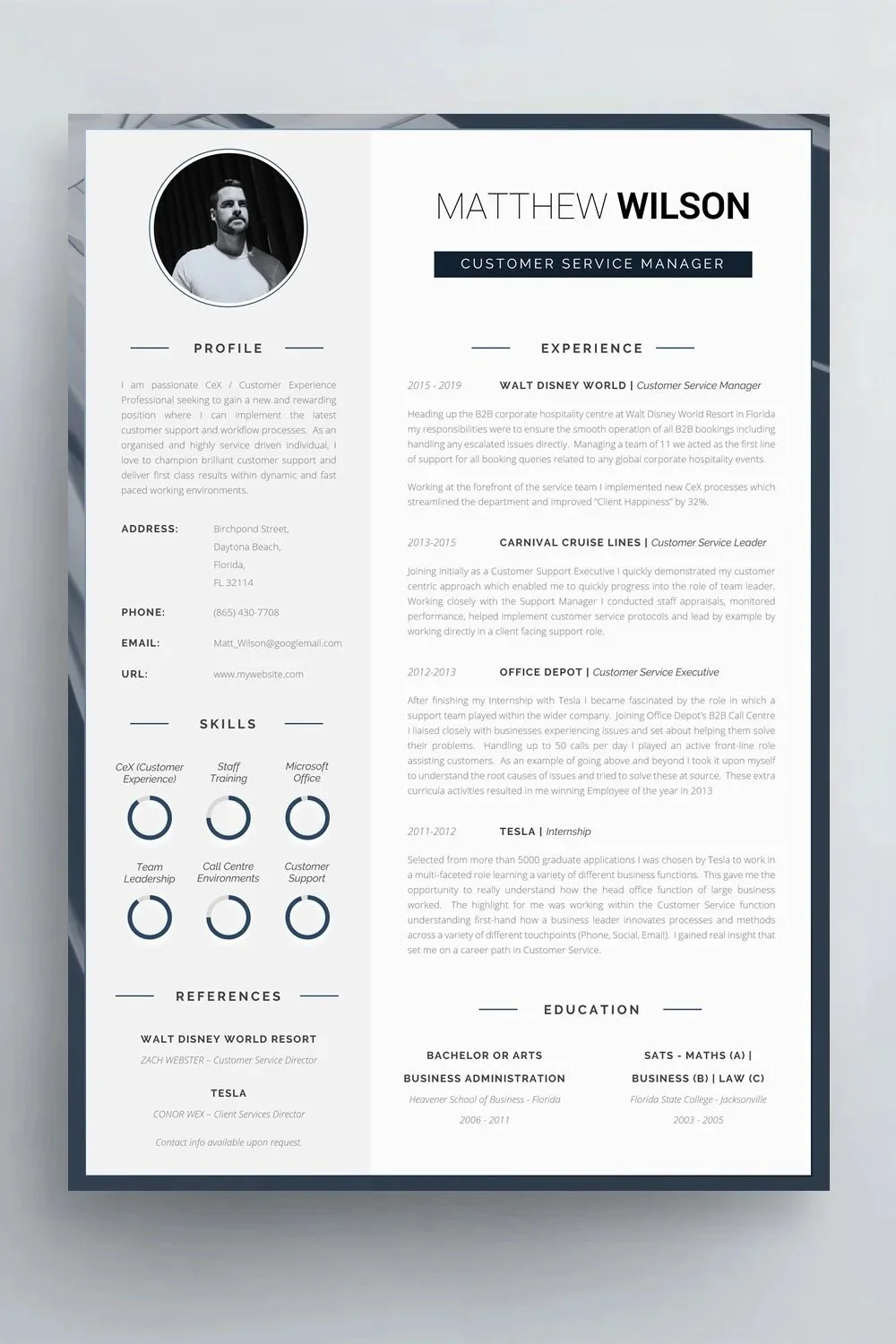
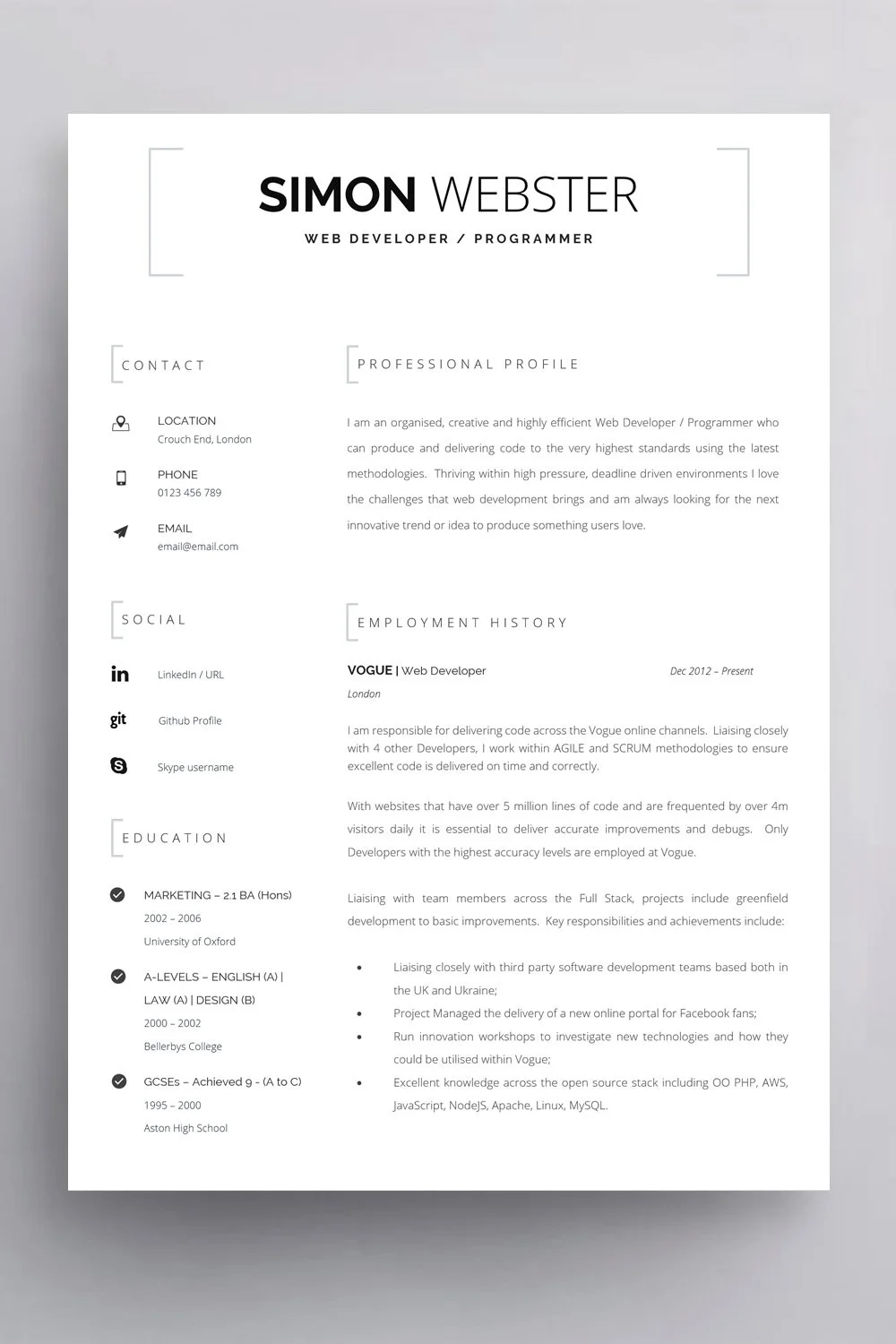
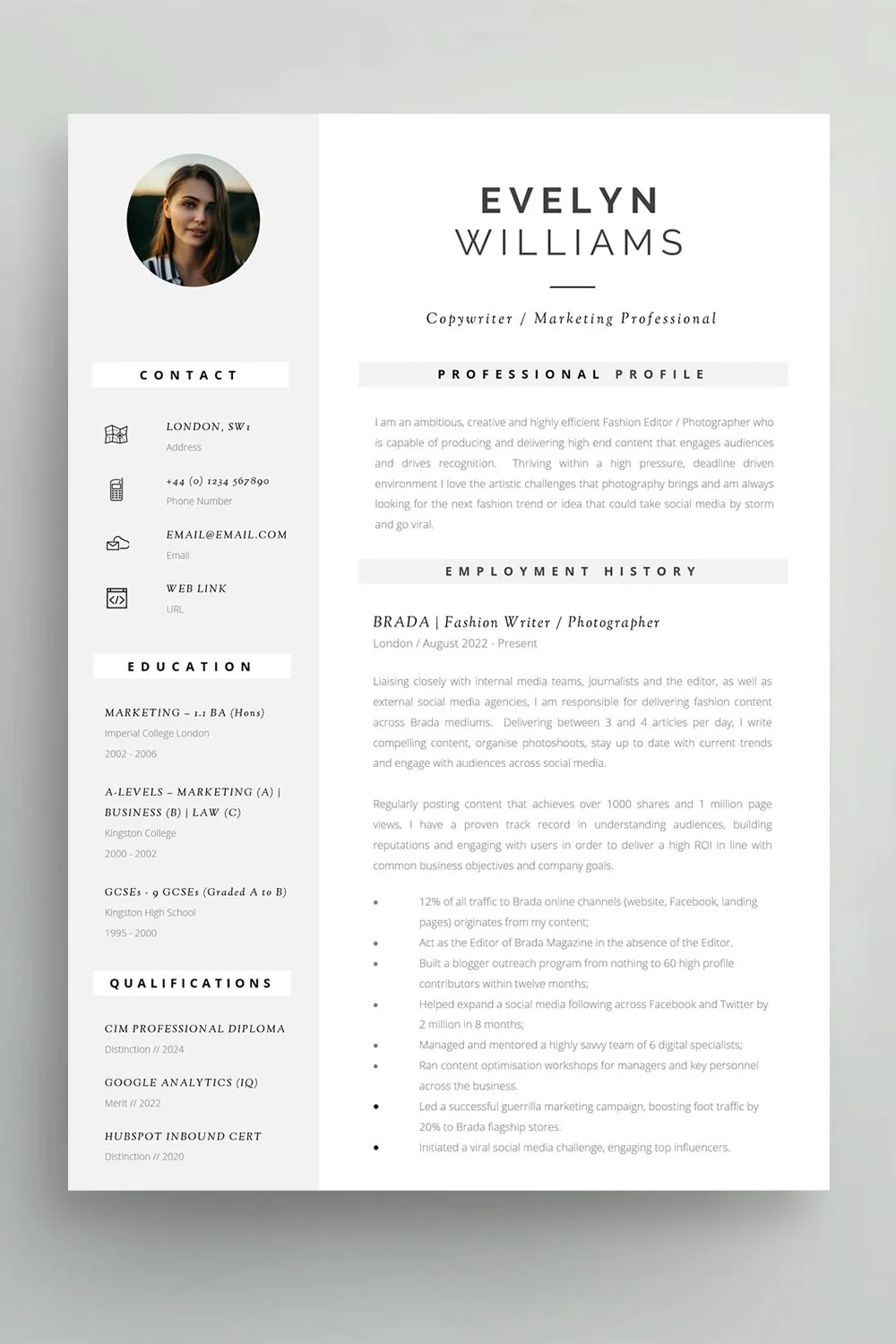
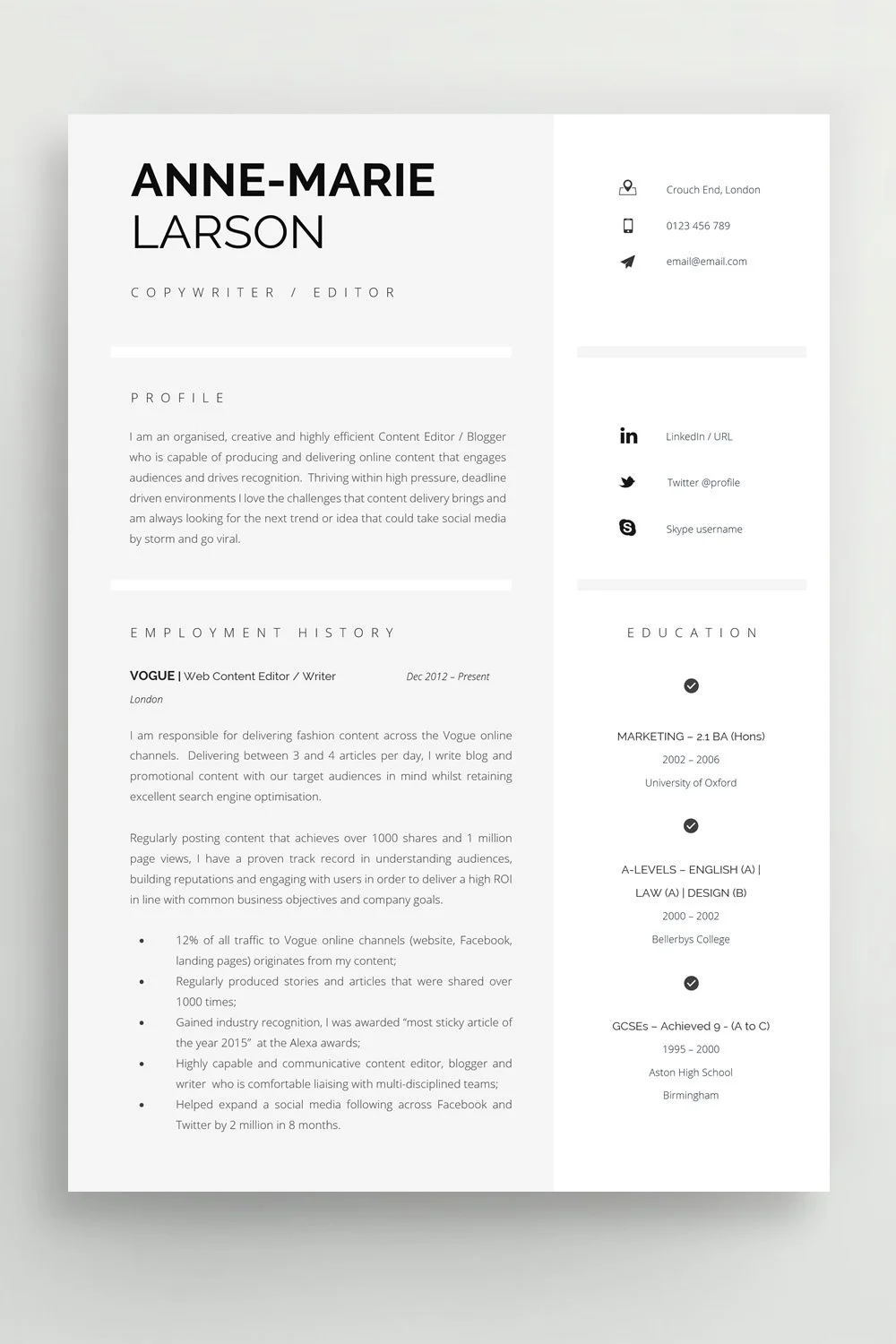
For most jobseekers, the best CV template is a clean, reverse chronological layout that makes recent and relevant experience easy to find.
That doesn't mean every good CV has to look the same.
A senior executive may need considerably more room for achievements and career history than a graduate.
A designer may reasonably want more visual personality than an accountant.
Someone with strong technical skills may benefit from a second column.
While a traditionalist might prefer a clean single column structure with professional fonts.
The design should support the information rather than compete with it.
If a recruiter has to work out where your current job is, hunt for your employment dates or decipher what each section means, the template isn't doing its job.
What’s in This Guide…
What makes a good CV template?
Do I need a CV template?
Benefits of using a CV template
CV template examples
- Professional CV templates
- Creative CV templates
- Modern CV templates
- Simple CV templates
- Student and graduate CV templates
How long should a CV be?
One column or two column CV template?
Are CV templates ATS friendly?
Word / PDF CV template - The best format
How recruiters actually scan a CV
How to choose the right CV template
Free CV templates
Browse all CV templates
CV templates FAQs
1. What Makes a Good CV Template?
A good looking CV and a good CV template aren't necessarily the same thing. You can make almost any document look impressive in a product mock up. The real test comes when you replace the sample content with ten years of your own employment history and somebody has to actually read it.
Look for a template with the following:
CLEAR STRUCTURE
Your name, job titles, employers, dates and section headings should all be immediately distinguishable.
ENOUGH WHITE SPACE
Information needs room to breathe. Trying to squeeze everything onto one page usually makes a CV harder to read rather than better.
CONSISTENT FORMATTING
Dates, headings, fonts, spacing and bullet points should follow the same pattern throughout.
FLEXIBLE SECTIONS
You should be able to add, remove and rearrange sections depending on what matters to your application.
READABLE TYPOGRAPHY
Interesting fonts are fine. Difficult to read fonts aren't.
A NICE AMOUNT OF SPACE
A good template will allow you to add extra pages and extend the design beyond to match your level of experience.
In addition to the obvious design, layout and formatting, a good CV template bundle should also include all the supporting documents in a matching style such as the cover letter template, references template and if created by someone who understands recruitment then supporting advice and guides.
A good CV Template will often provide way more value than just a single template.
2. Do I Need a CV Template?
“I can just patch something together myself?” or “Are CV Templates Worth it?” I hear you ask. But, let’s hear from Team Sky legend Sir Dave Brailsford on marginal gains before answering:
"The whole principle of marginal gains came from the idea that if you broke down everything that could impact on a cycling performance — absolutely everything you could think of — and then you improved everything little thing by 1%, when you clump it all together, you're going to get quite a significant increase in performance. So we set about looking at everything we could."

Take inspiration from Team Sky.
A CV Template is the equivalent of a bike in Team Sky, improving it by just a small percent might just be the difference you need to achieve a call back or get invited in for an interview. A CV Template is one part of the job search process that allows you to achieve these marginal gains
Team Sky famously went to extreme lengths to identify and leverage marginal gain opportunities. Aside from the obvious tweaks to fitness, nutrition and aerodynamics they go granular, improving every area of potential weakness.
Examples of this include employing their own cleaners that travel with the Tour de France team to deep clean each hotel room at each stopover point in order to minimise the risk of catching colds and viruses. The team also take their own pillows with them - when you’re on stage 19 and you have 230km to do the following day, what price can you put on a good nights sleep!
You might not want to go to the extreme lengths that Team Sky do, however it’s worth thinking about how you can improve each aspect of your job search, an amazing CV is a great start, but consider other things like planning your journey, taking an early night etc. This Job search checklist should help you tick things off.
3. Benefits of Using a CV Template
PROFESSIONAL DESIGN & LAYOUT
A well designed template gives you a clear structure from the start. Rather than worrying about margins, spacing, fonts and layout, you can concentrate on the information that actually needs to go into your CV.
SAVE TIME
Creating a CV from a blank Word document can take considerably longer than expected. A template gives you the basic structure immediately and makes it much easier to create tailored versions for different applications.
INFORMATION STRUCTURE
A good template helps you decide where your profile, experience, education, skills and other information should sit. It also gives each section an appropriate amount of space rather than treating everything as equally important.
EASIER TARGETING
You should tailor your CV for the role you're applying for. Working from an editable template makes it easier to change your profile, reorder skills, adjust achievements and emphasise different parts of your experience without rebuilding the document every time.
CONSISTENT APPLICATION MATERIALS
Many premium CV templates also include matching cover letters and supporting pages. This gives your application a consistent visual identity without you having to design every document separately.
4. CV Template Examples
Typically there are five main categories for CV templates:
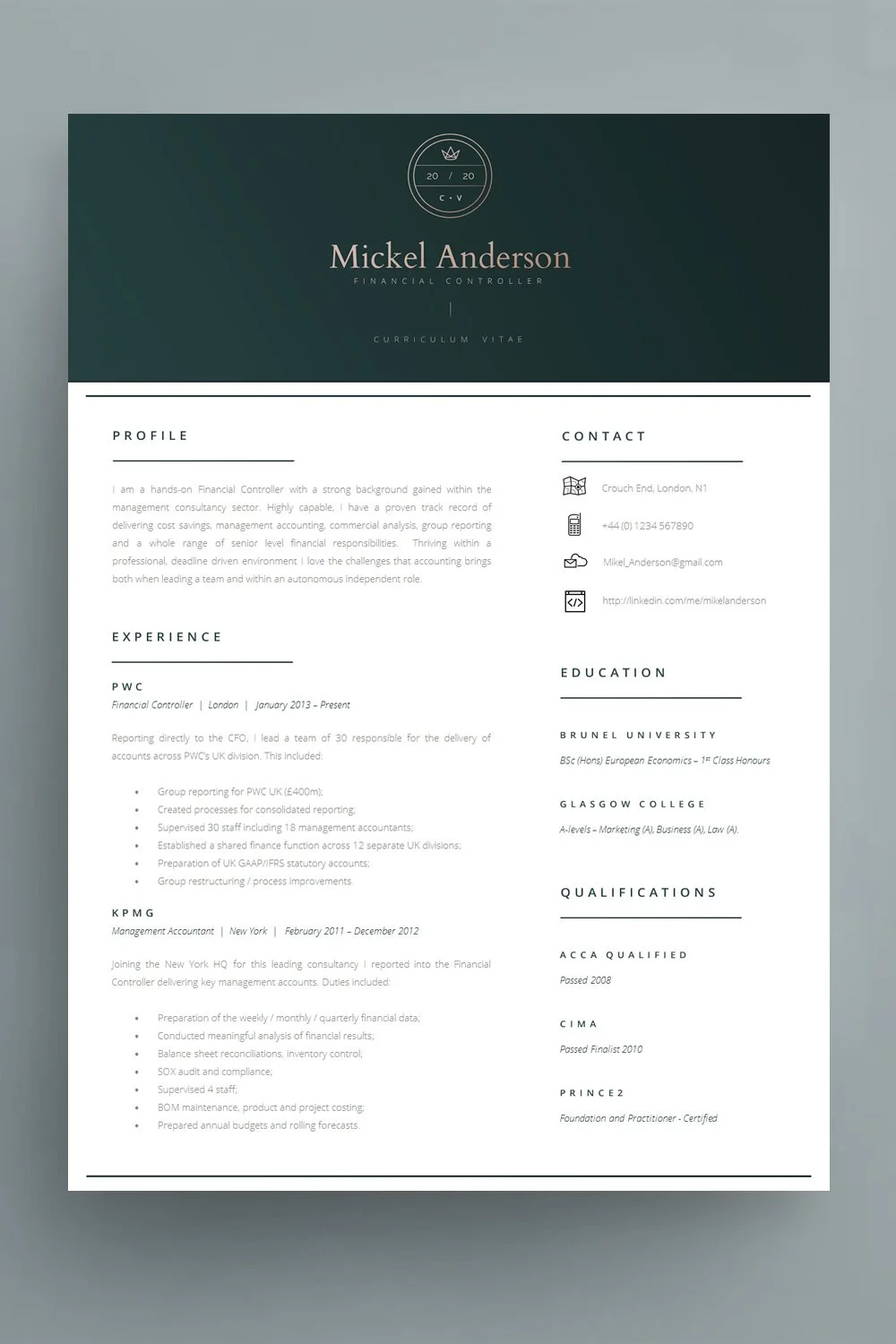
PROFESSIONAL CV TEMPLATES
Best for: finance, law, operations, HR, management, engineering, consulting and senior professional roles.
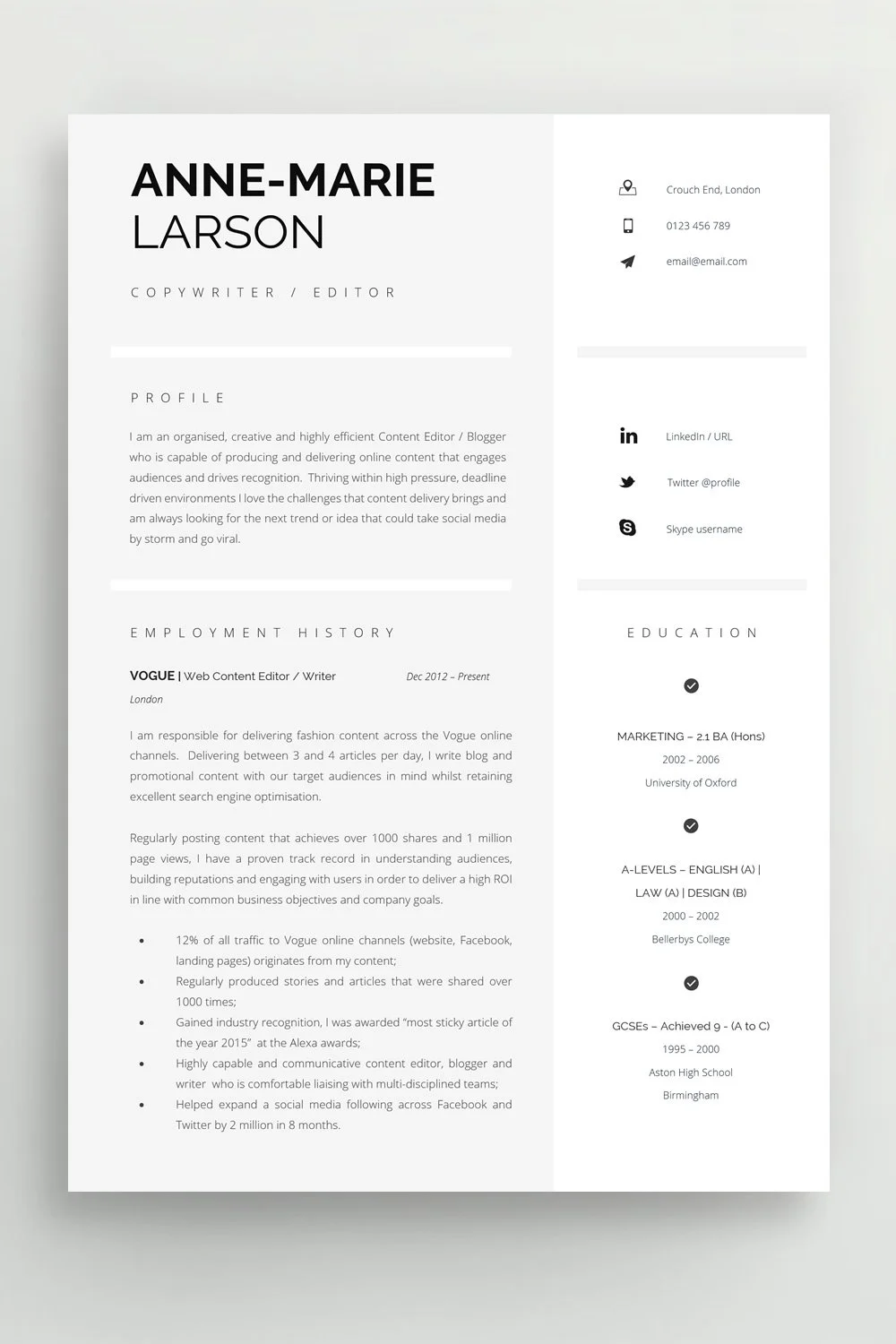
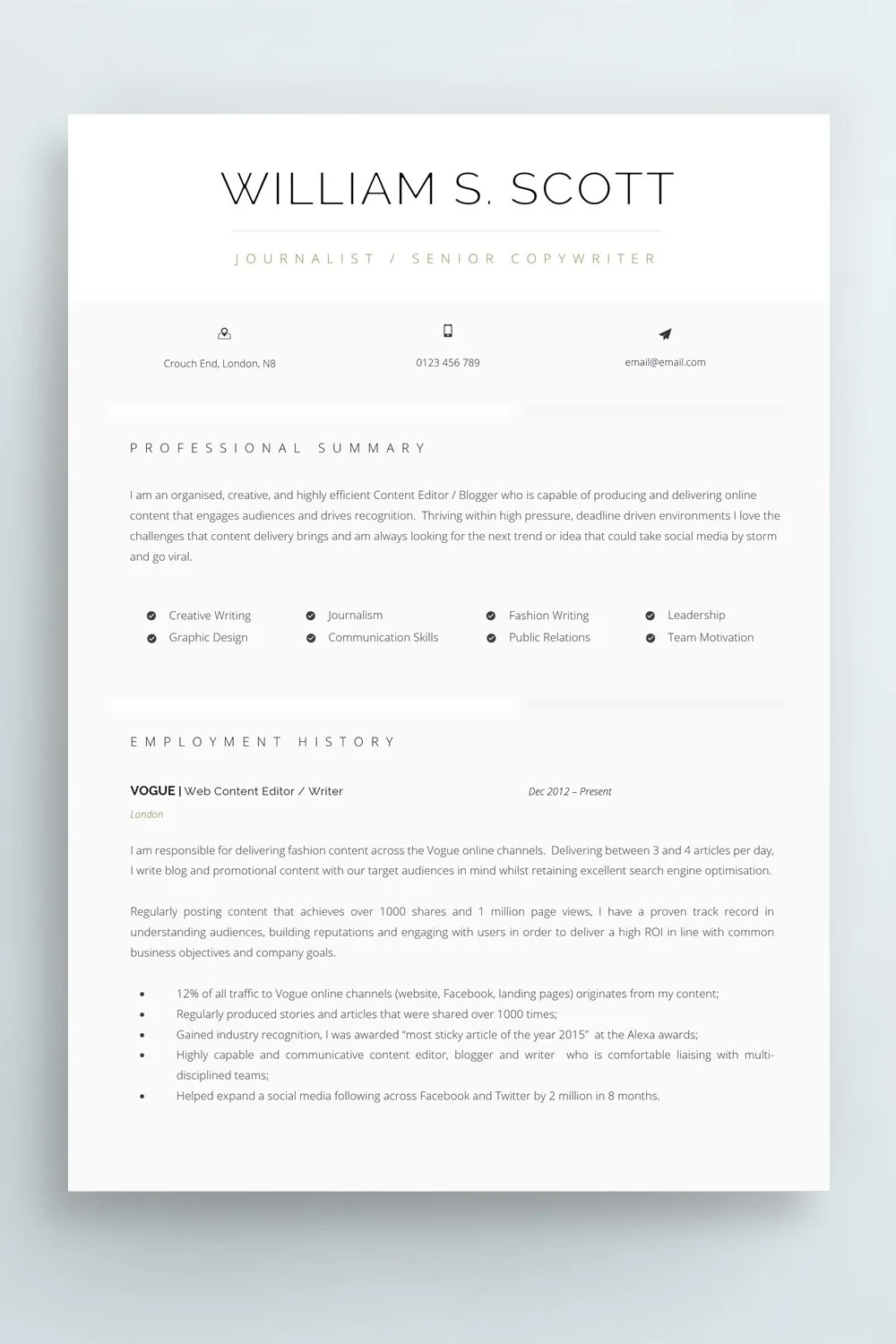
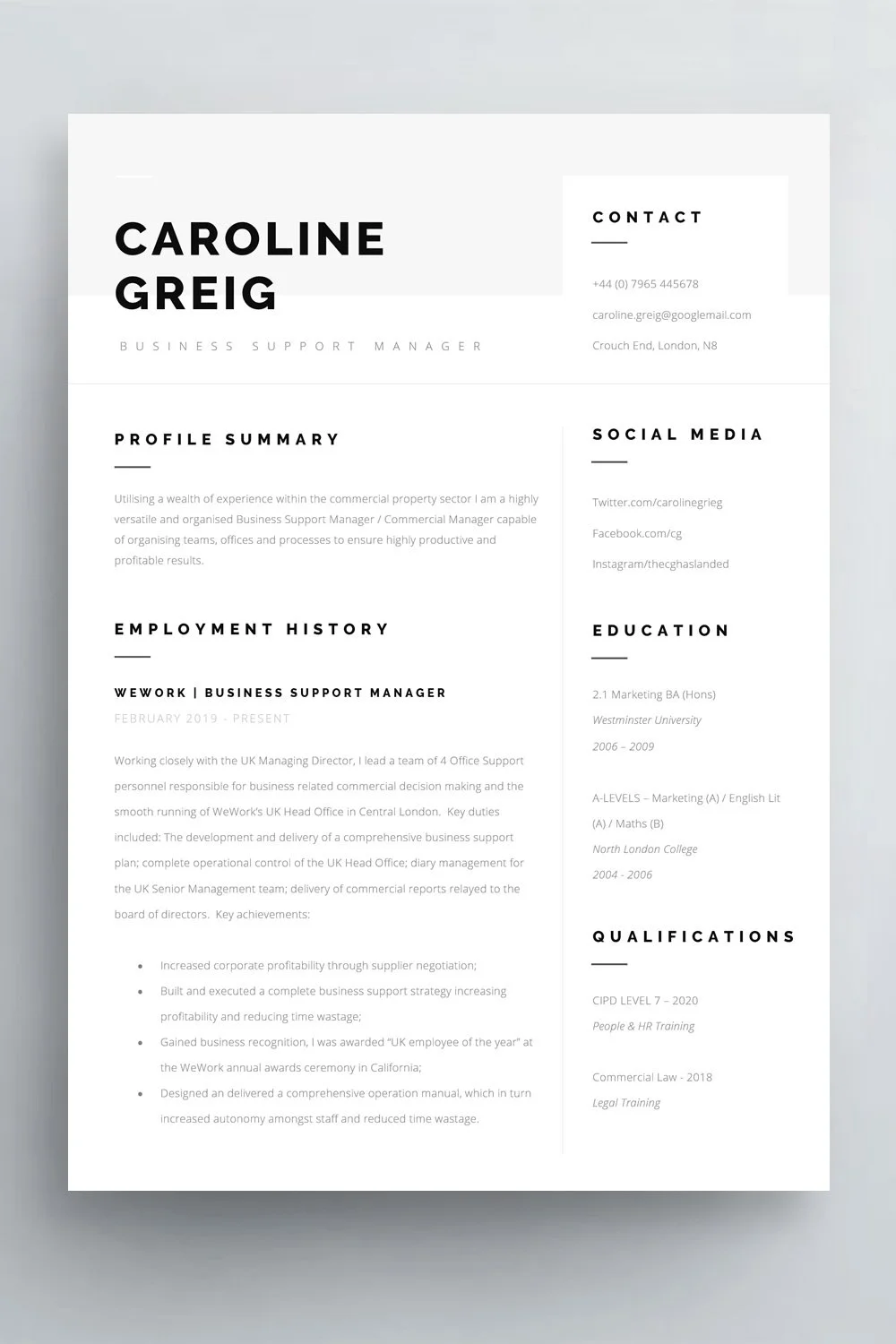
Professional CV templates are deliberately restrained. Expect clean typography, sensible spacing, limited colour and an emphasis on employment history and achievements rather than decoration. Examples:
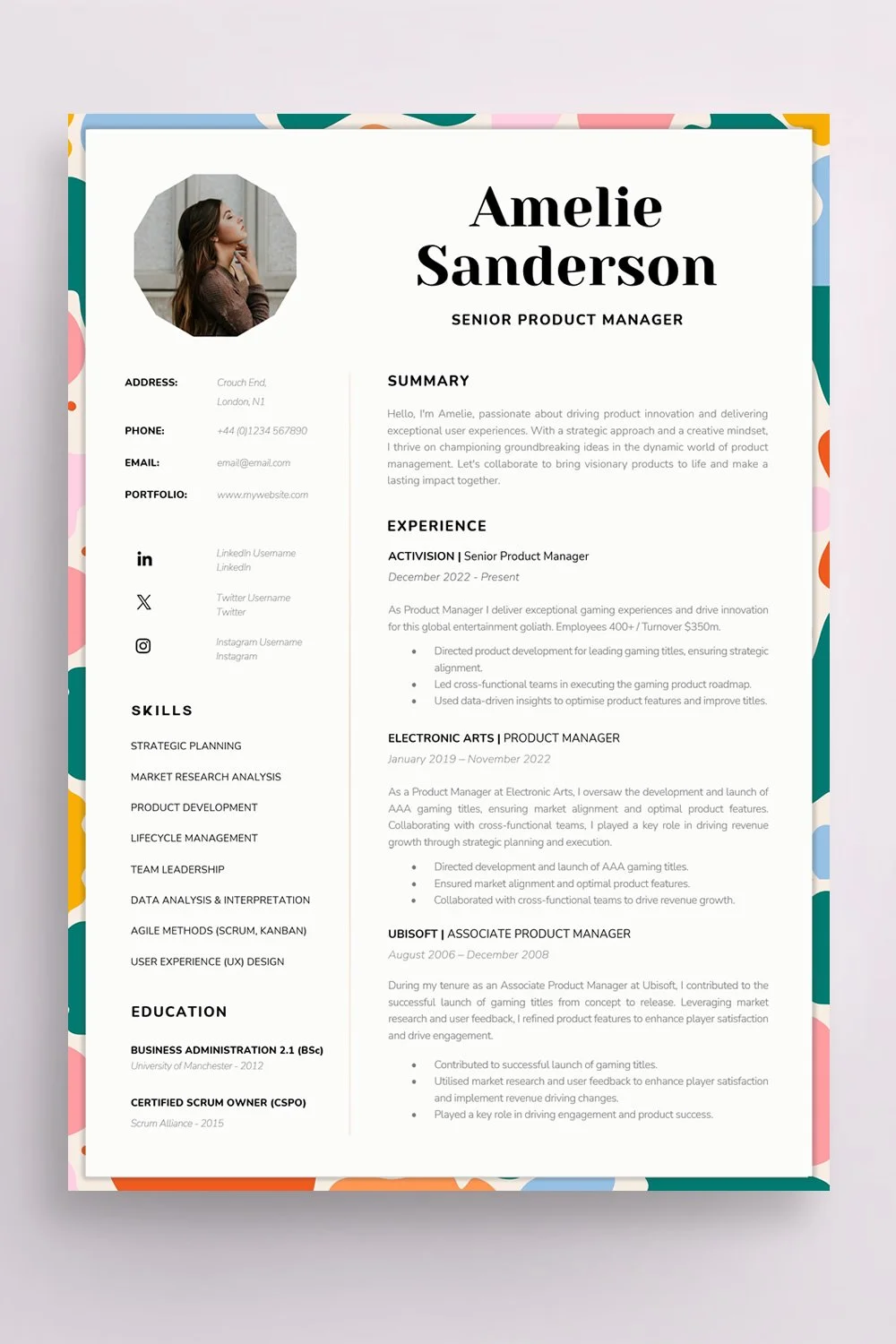
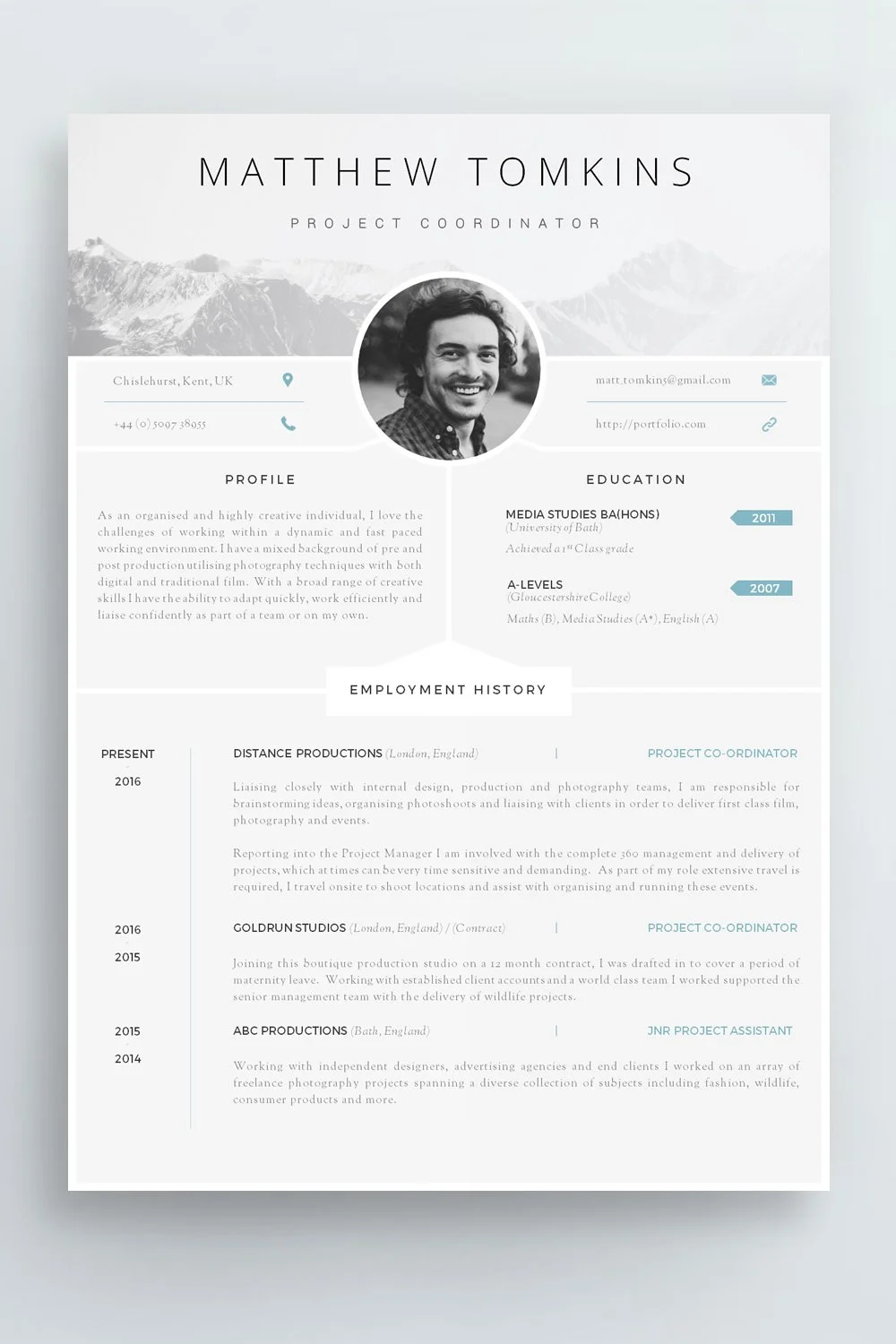
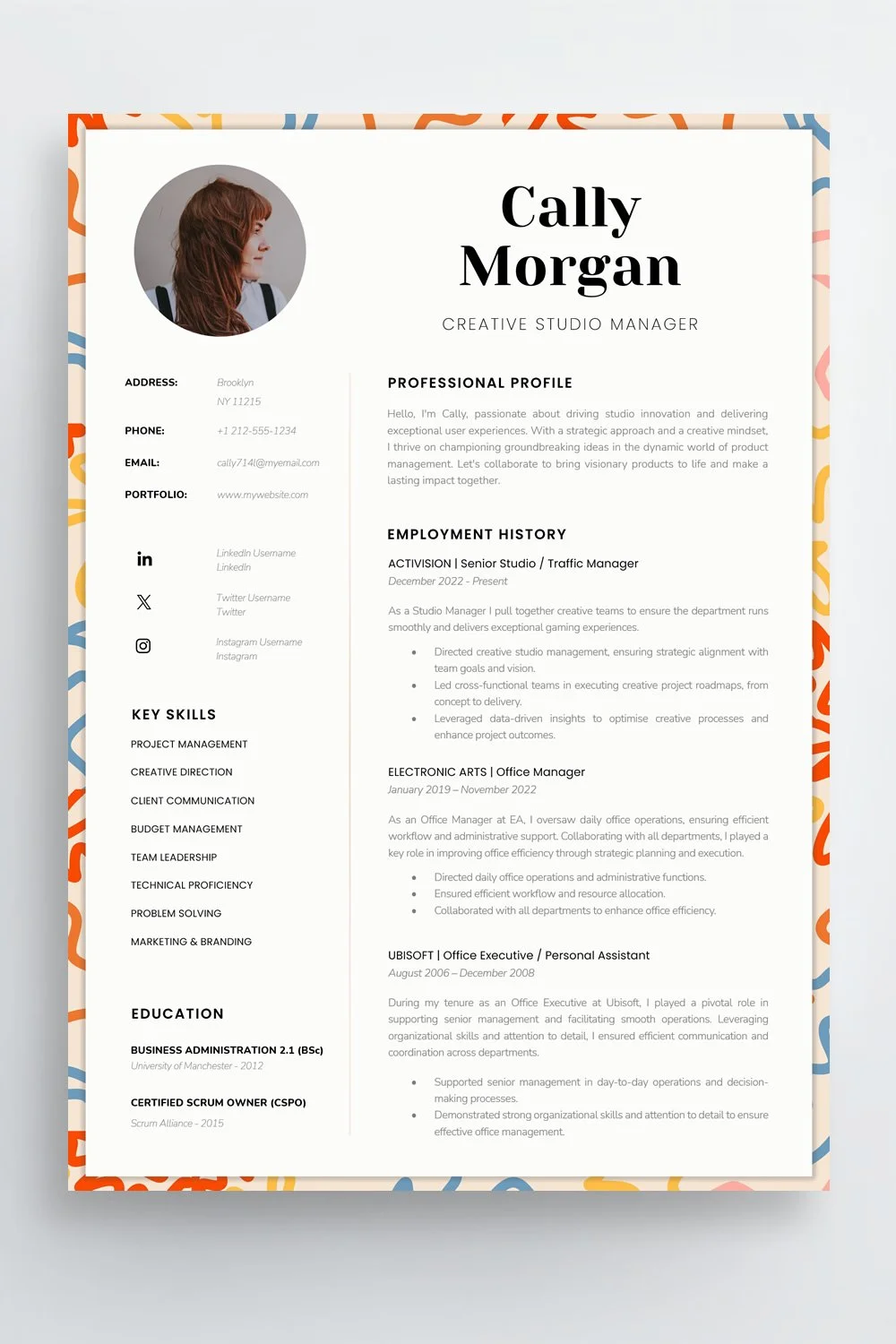
CREATIVE CV TEMPLATES
Best for: design, creative, marketing, social media, editorial, fashion, illustration, animation and digital roles.
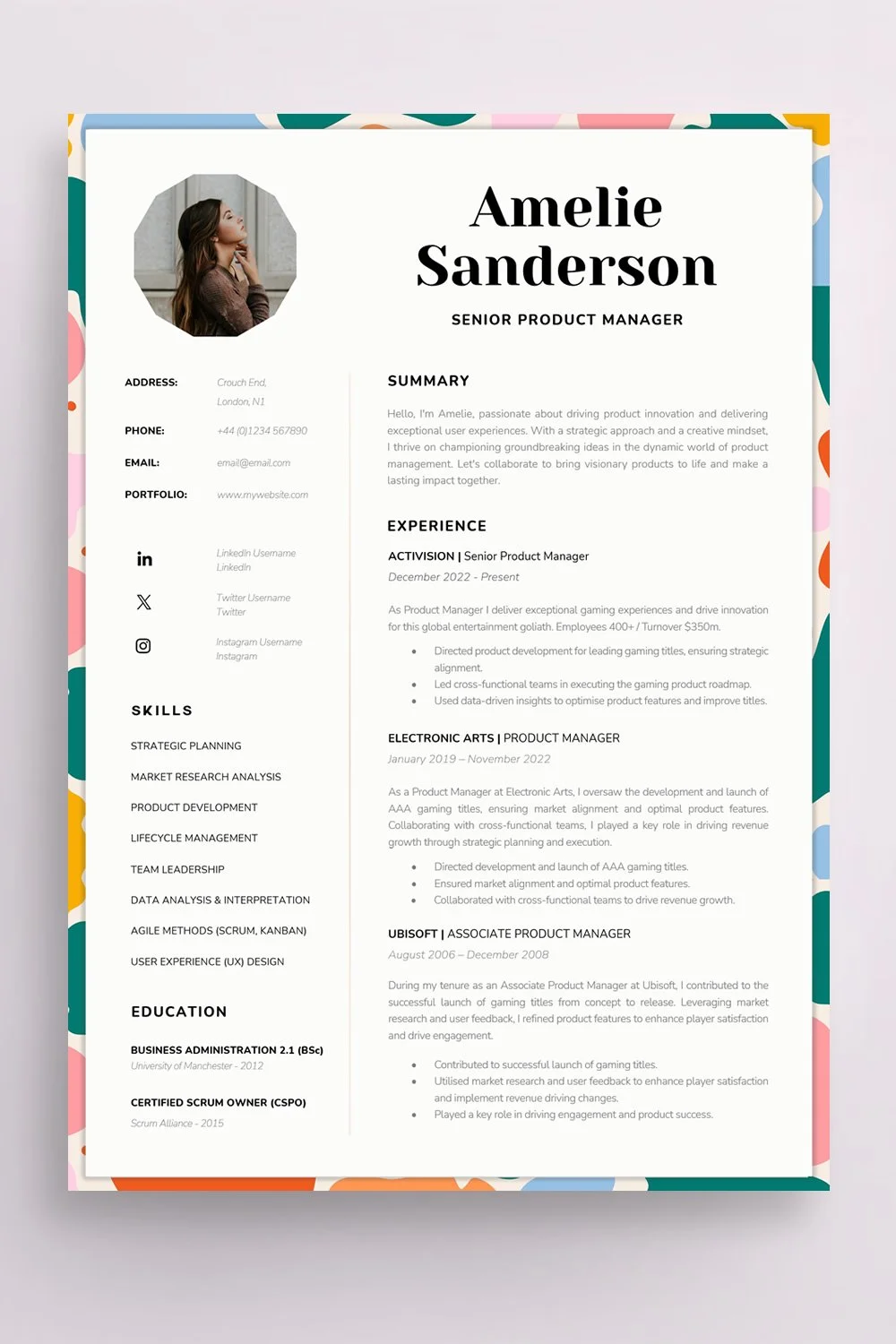
Creative CV templates are designed to catch the eye. Expect pops of colour, nice fonts, photos and a unique and interesting feel. Used typically for more creative profesions, they can be a nice way to express personality for wider roles. Examples below with further creative CV examples here:
MODERN CV TEMPLATES
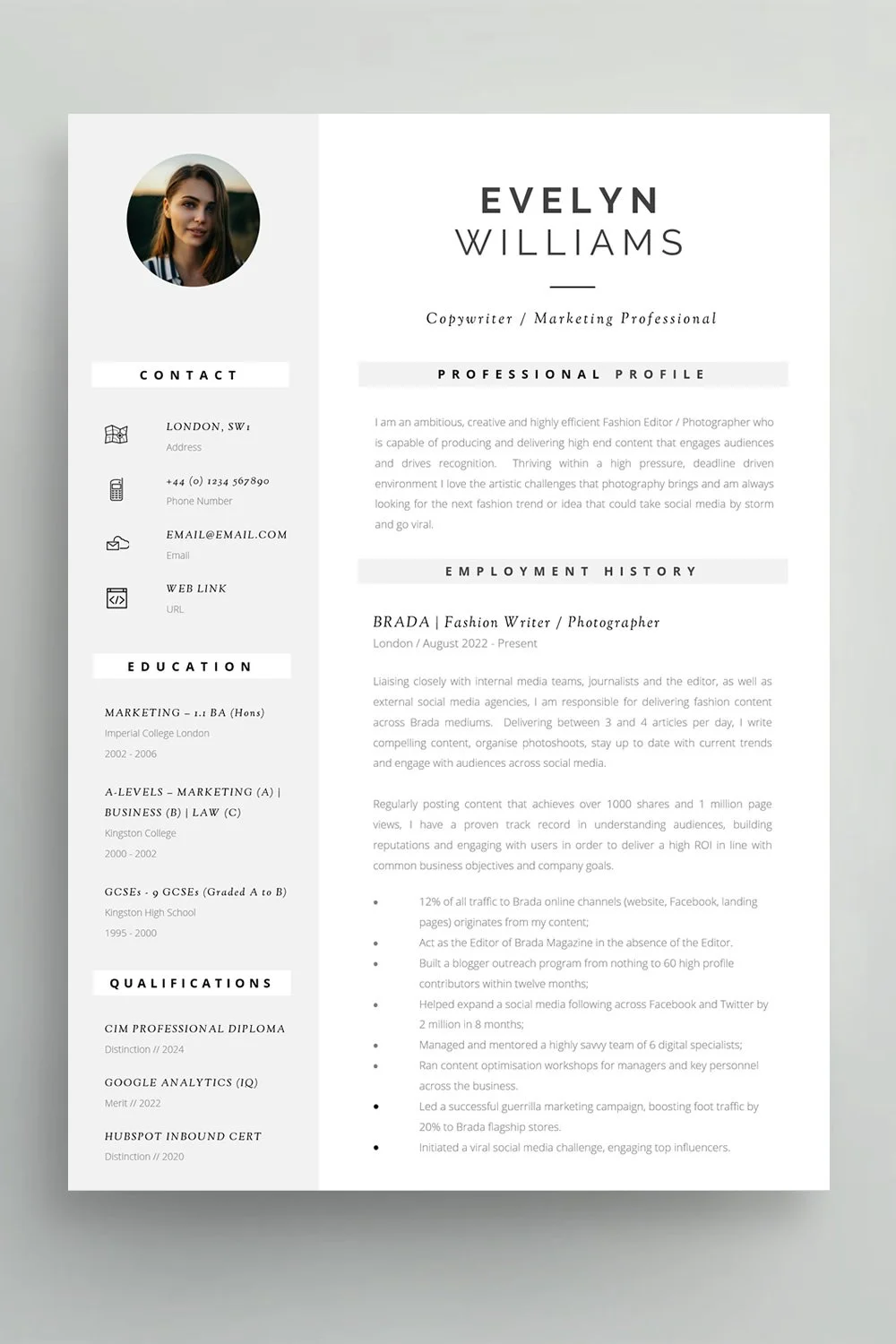
Best for: marketing, sales, technology, project management, commercial roles, start-ups and candidates who want a more contemporary look.
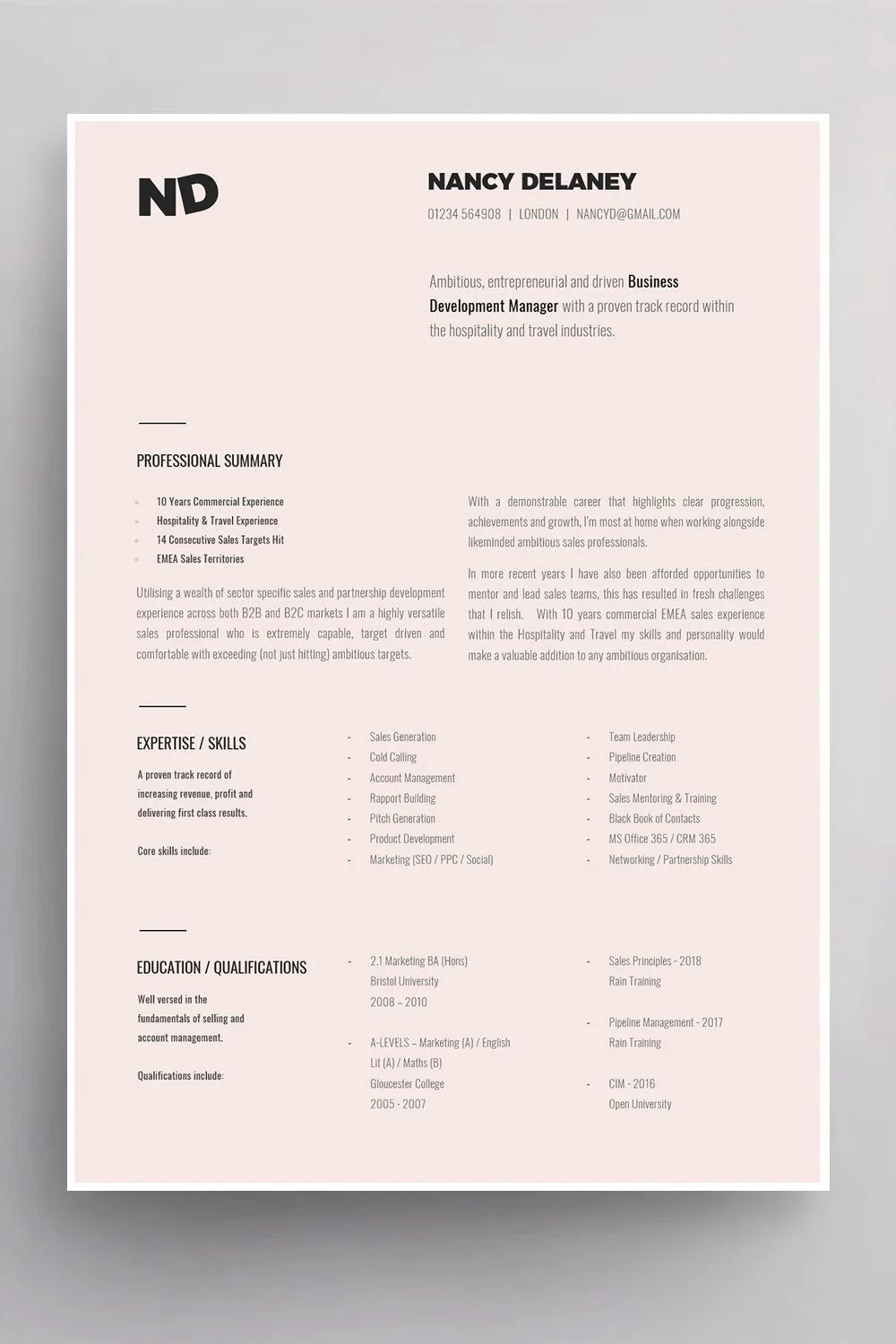
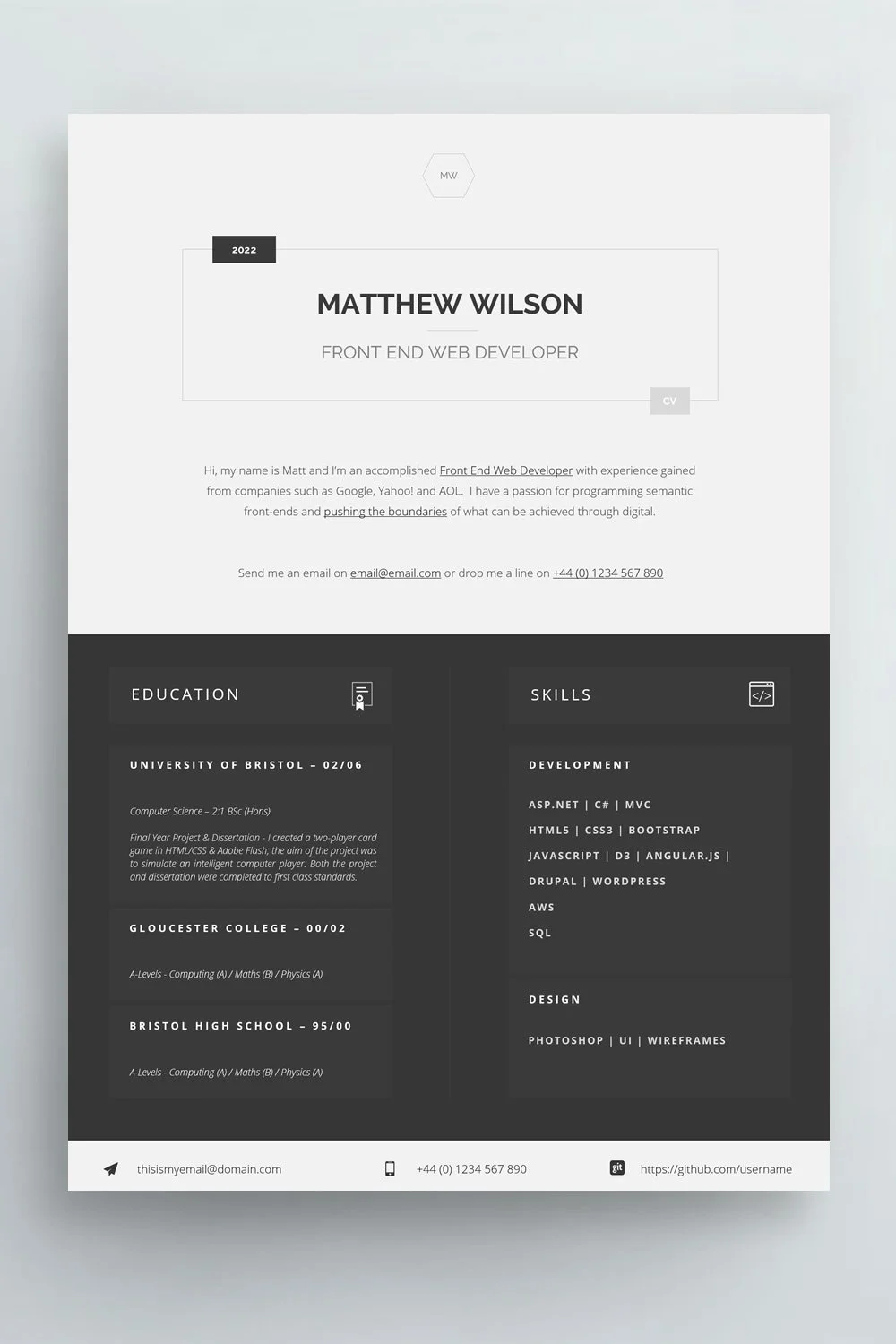
Modern CV templates introduce more visual structure without becoming overly creative. They may use subtle colour, stronger typography, carefully designed sections or a two column layout to organise information more effectively. The aim is to create a CV that feels current and polished while still keeping the content easy for a recruiter to scan. Examples below with further modern CV examples here:
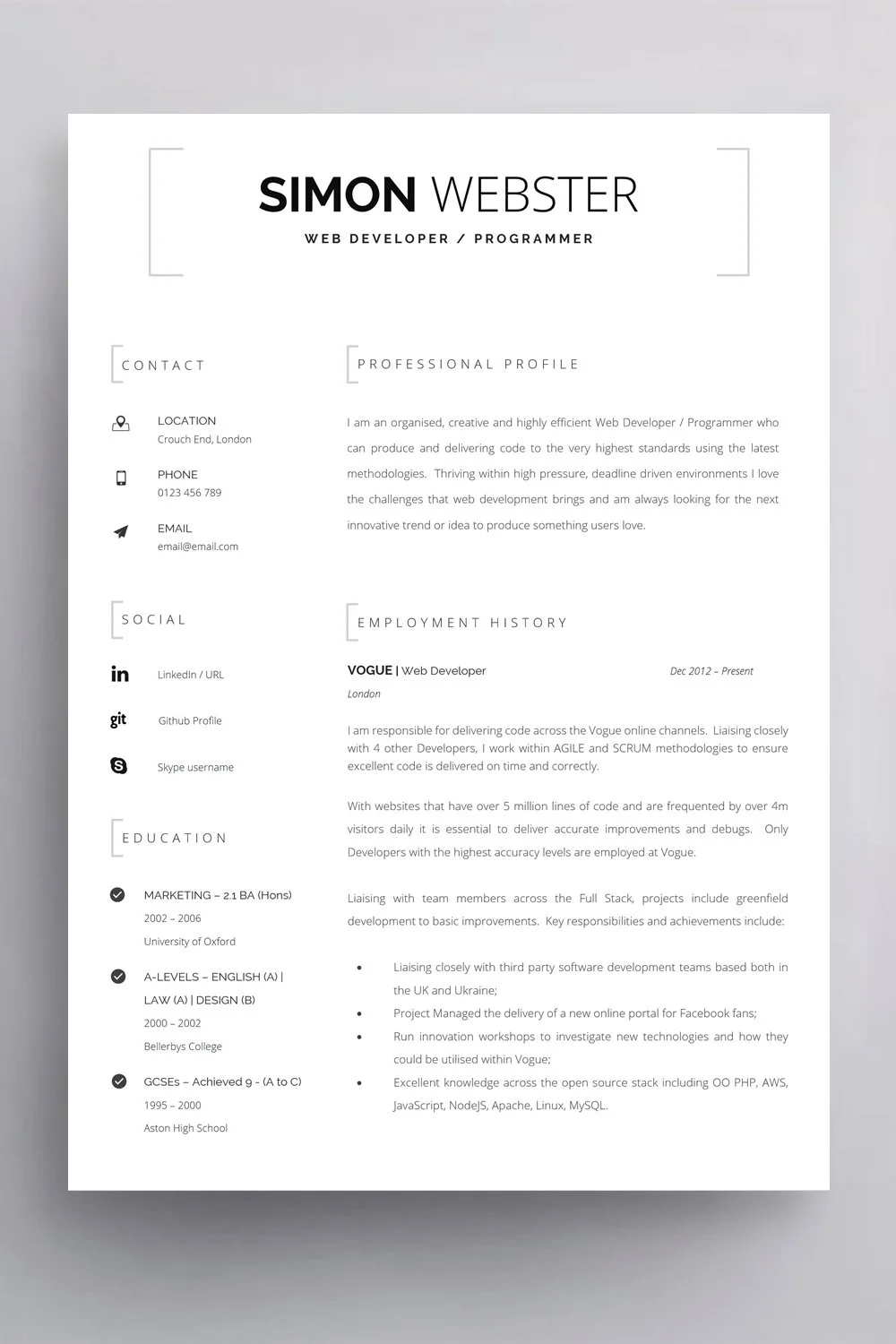
SIMPLE CV TEMPLATES
Best for: administration, customer service, education, healthcare, public sector, support roles and anyone who wants a clean, uncomplicated CV.
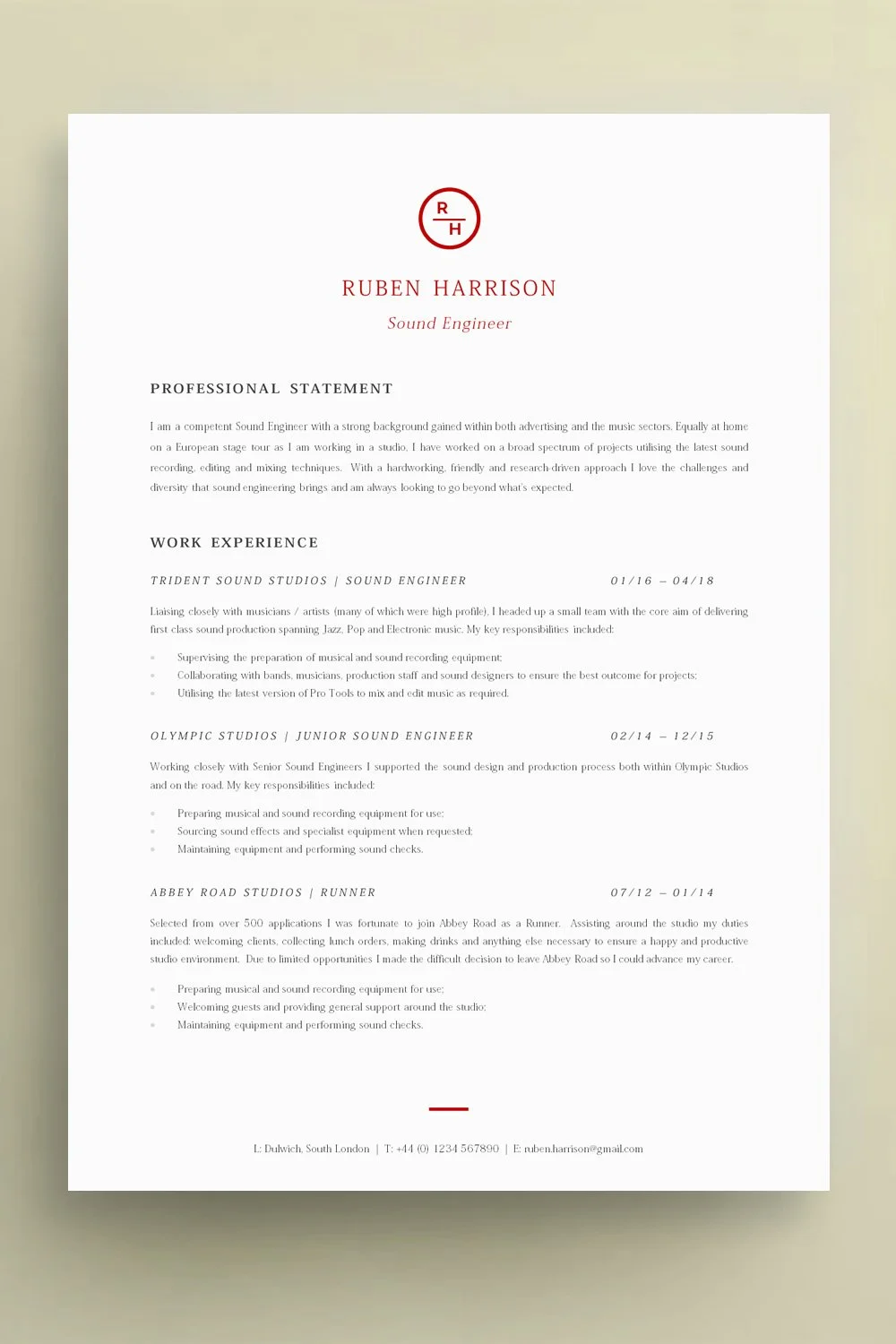
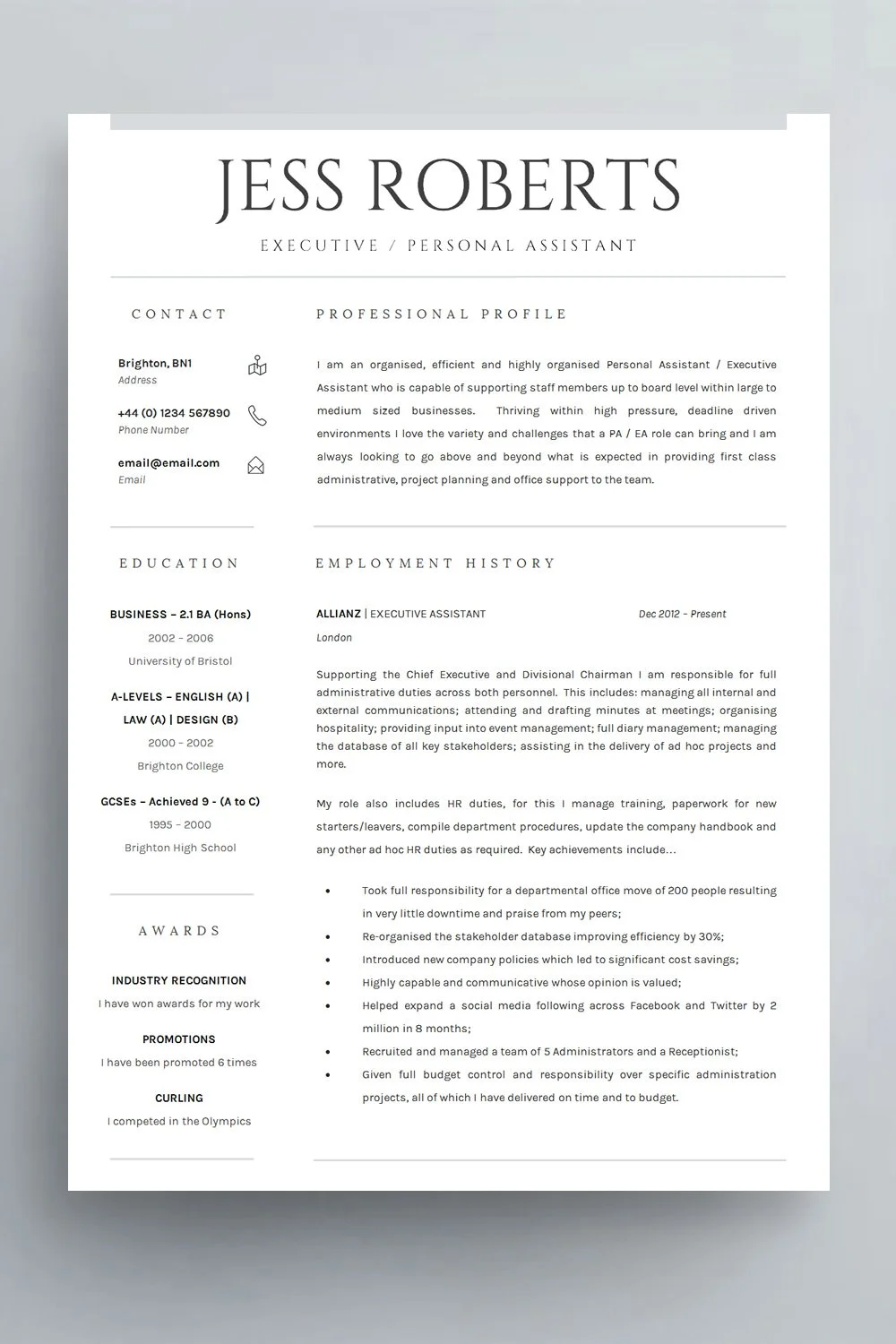
Simple CV templates strip away unnecessary design and put the focus firmly on your experience, skills and achievements. Expect clear headings, straightforward typography, plenty of white space and an obvious reading order. Examples below with further simple CV examples here
STUDENT CV TEMPLATES
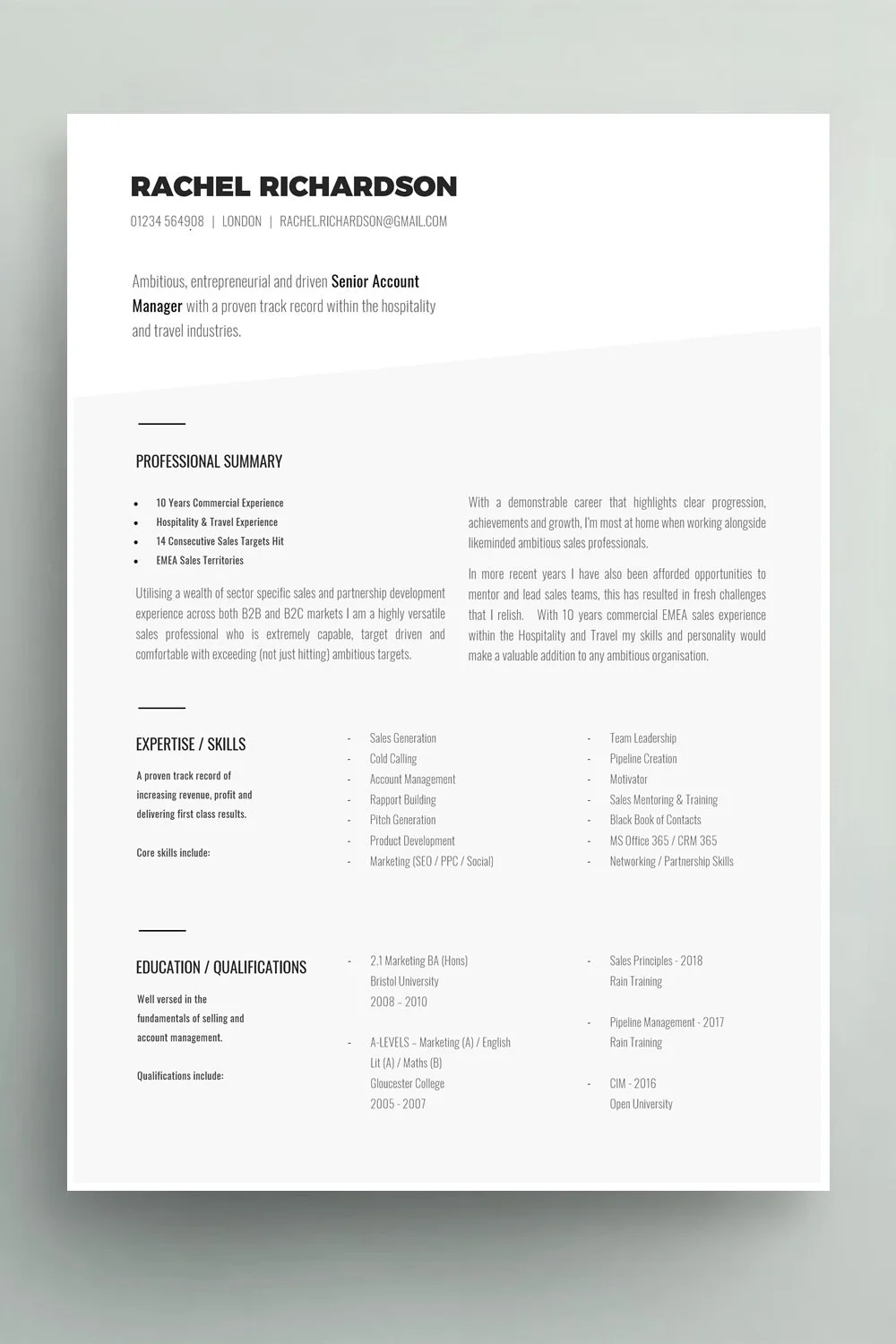
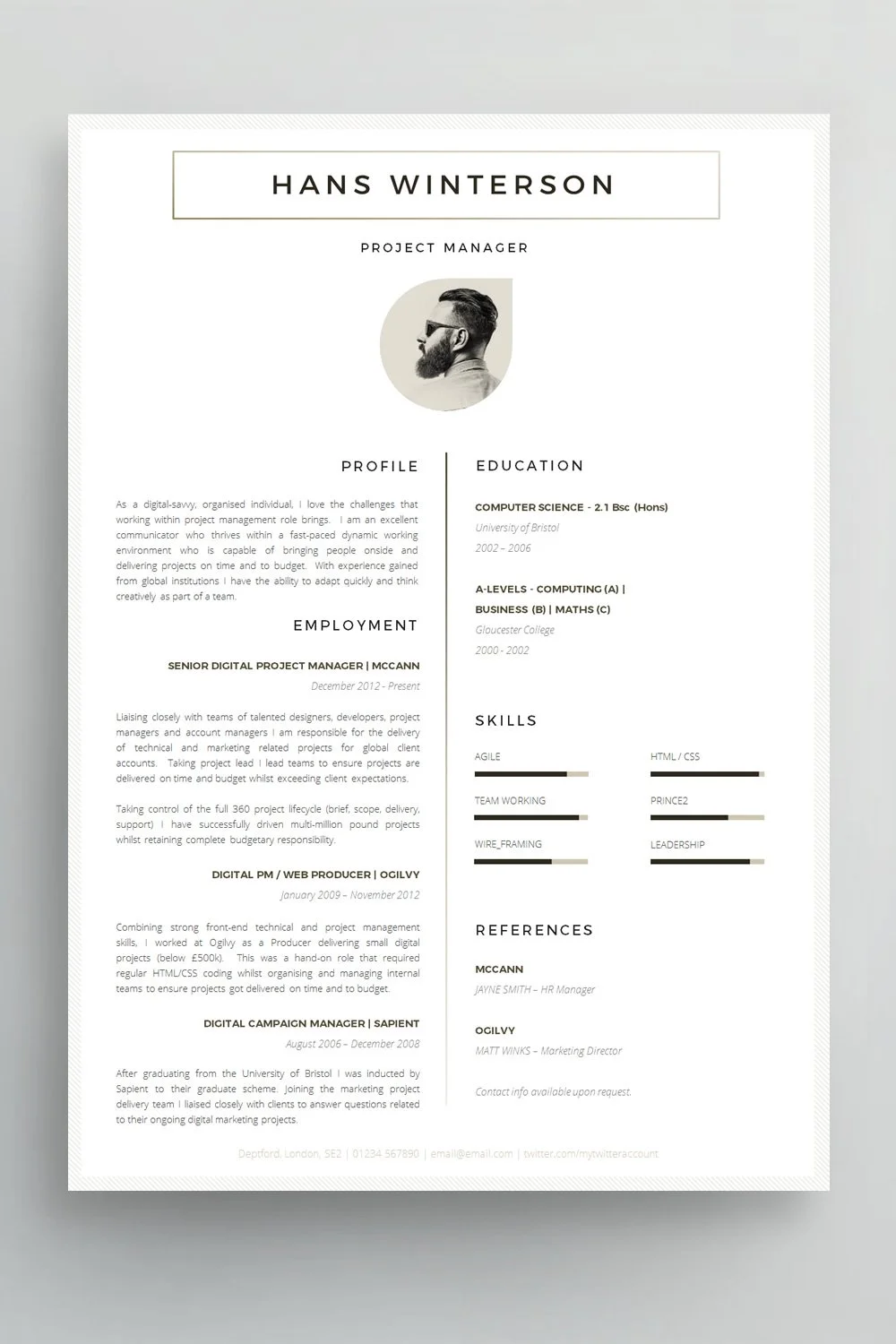
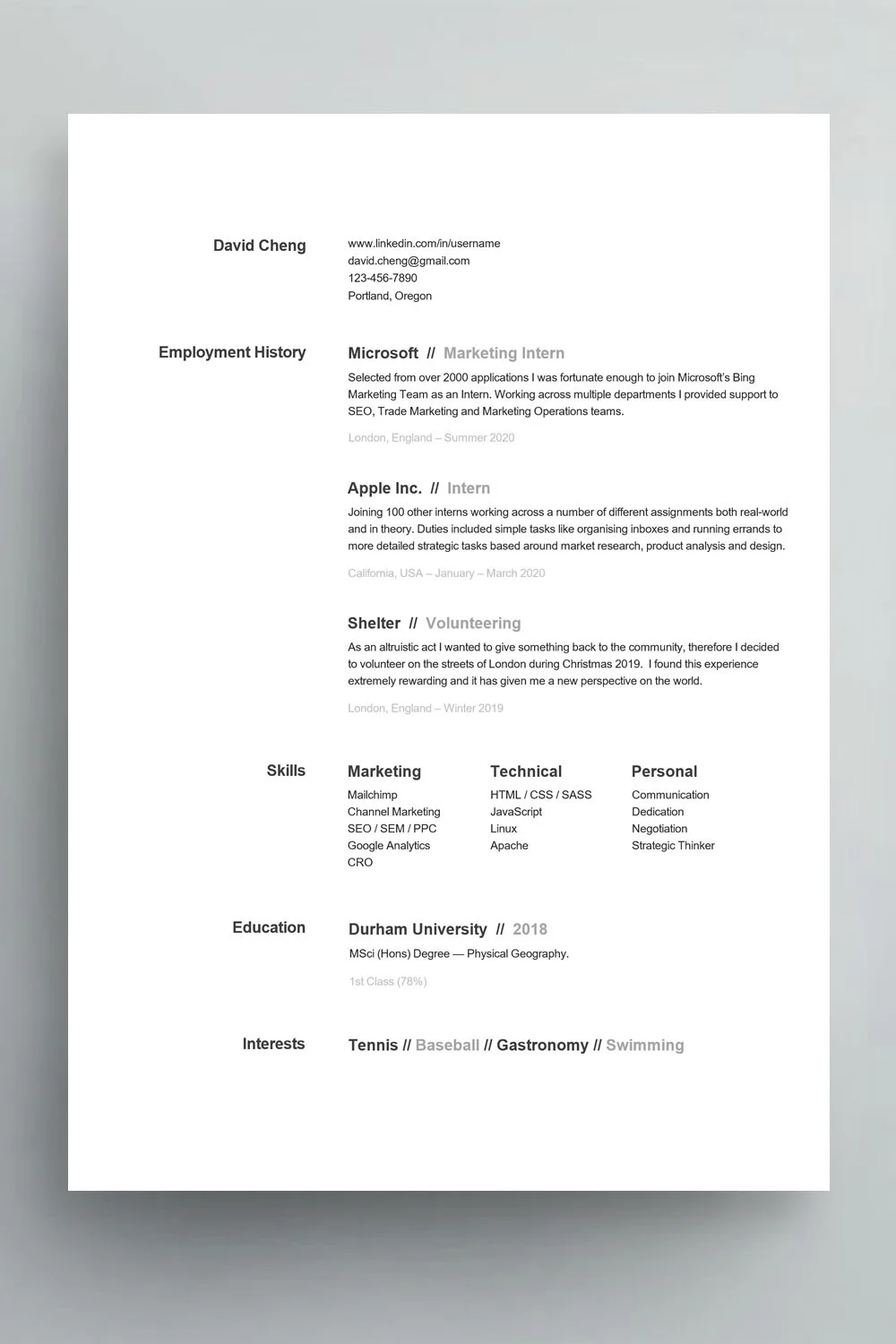
Best for: school leavers, college students, university students, graduates, apprentices and anyone writing a CV with limited work experience.
Student CV templates are designed to make the most of the experience you do have. Rather than relying heavily on employment history, they create more space for education, projects, volunteering, skills, achievements and extracurricular activities (how to write a student CV and how to write a CV with no experience). A good student CV should help you demonstrate potential and transferable skills without making the document feel empty simply because you are at the start of your career.
5. How Long Should a CV Be?
There is no perfect CV length. The right length depends on how much relevant information you have to communicate.
A single page can work extremely well for a school leaver, graduate or someone early in their career. Two pages is completely normal for an experienced professional, while longer CVs can make sense where the role genuinely requires extensive publications, projects, research, clinical experience or technical information.
The important word is relevant. Don't remove useful achievements simply because somebody told you a CV must fit onto one page. Equally, don't stretch a limited amount of experience across two pages because you've heard that a professional CV should always be longer.
ONE PAGE CV
Often suitable for students, graduates, school leavers and candidates with limited experience.
TWO PAGE CV
A common choice for experienced professionals who need more space for employment history, skills and achievements.
THREE PAGES OR MORE
Can be appropriate where extensive publications, projects, research, clinical work, exhibitions or other specialist information genuinely needs to be included.
A flexible CV template should allow you to add or remove pages as your career develops.
TIP: When deciding whether something deserves space on your CV, ask yourself one question: does this make me more relevant to the job I'm applying for?

6. One Column or Two Column CV Template?
Neither format is automatically better. The right choice depends on the information you need to present and where you're sending the CV.
One Column CV Templates
A single column CV has one obvious reading path from the top of the page to the bottom.
This makes it simple, predictable and particularly useful when you want maximum compatibility across different recruitment systems.
It also gives employment history plenty of horizontal space.
Best for:
traditional professional applications
long or detailed employment histories
applications where you want to take the safest approach to ATS parsing
candidates who prefer a simple CV
Two Column CV Templates
A two column CV separates primary information from supporting information.
Typically, the wider column contains your profile and employment history while the narrower column carries contact details, skills, qualifications or other supporting information.
Used properly, this can make excellent use of space and make a CV easier for a person to scan.
Best for:
professional candidates with several supporting skills or qualifications
technical roles
modern CV designs
candidates who need to organise a lot of information without making the page feel crowded
The important qualification is used properly.
A badly constructed two column CV can create problems if recruitment software extracts the text in the wrong order. If you're applying through a recruitment portal and want the most conservative option possible, a clean single column CV remains the safer choice.
If you prefer a two column design, check the finished document by copying all of the text into a plain text editor. If the information comes out in a logical order, that's a useful basic check that the document structure hasn't become scrambled.
7. Are CV templates ATS Friendly?
Yes, a well designed CV template can be ATS friendly. Modern Applicant Tracking Systems are considerably more capable than early recruitment software, but that doesn't mean formatting is completely irrelevant.
The sensible approach is to make your CV straightforward for both software and the recruiter who eventually reads it.
Good practice includes:
Clear section headings
Recognisable job titles and dates
Selectable text rather than important information embedded inside images
Sensible fonts and font sizes
A logical reading order
Relevant terminology from the job description where it genuinely matches your experience
If you want the most conservative option possible, choose a straightforward single column template. If you prefer a more structured or two column design, make sure important information still follows a clear reading order and isn't hidden inside graphics.
And please don't build your entire CV around trying to achieve an imaginary ATS score.
The final document still needs to convince a human being.
8. Word / PDF CV Template – The Best Format
The simplest rule is to follow the instructions in the job advert. If an employer or recruiter asks for a particular file type, send that format.
For creating and editing your CV, Microsoft Word remains a practical choice because it is easy to customise and gives you an editable master document that you can tailor for future applications.
Once you're happy with the finished CV, saving a PDF version is useful because it normally preserves your fonts, spacing and layout exactly as you intended.
A sensible approach is therefore to keep both:
Word (.docx)
Your editable master copy.
PDF (.pdf)
A finished version ready to send where no other format has been requested.
Give the file a professional name too.
Instead of:CV_Final_New_V7.pdf
use something like:Richard_Smith_Marketing_Director_CV.pdf
For more detail, see our guide to the best file format for your CV.

Free version of MS Word is available to download here: https://products.office.com/en-gb/try
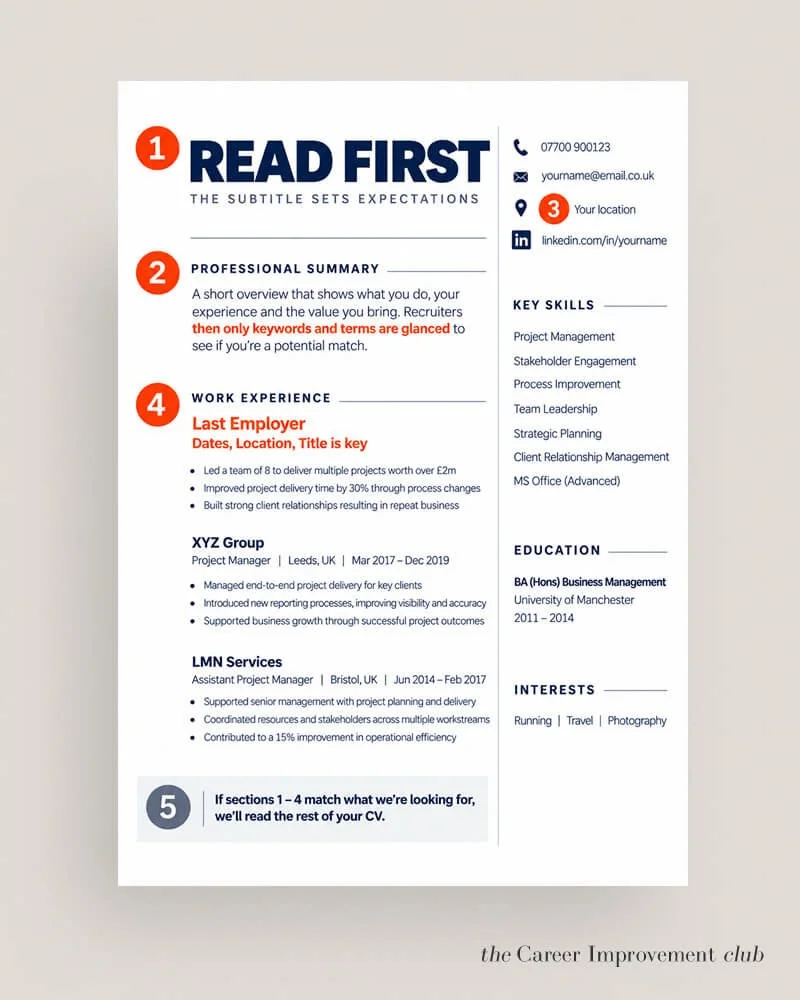
9. How Recruiters Actually Scan a CV
Recruiters rarely start by reading every word of a CV from top to bottom. The first pass is usually much quicker. They are trying to establish whether the application looks relevant enough to spend more time on.
They are likely to look for things such as:
your current or most recent job title
the companies you have worked for
how long you stayed in each role
relevant skills and qualifications
evidence of achievements
whether your experience broadly matches the vacancy
This is why good CV templates use clear headings, consistent dates, obvious job titles and enough space around important information.
Your most relevant experience should be easy to spot. Recent roles should normally carry more visual weight than jobs you held many years ago, and achievements should not disappear inside large paragraphs of text.
A good CV template does not need to grab the recruiter's attention with clever design.It needs to guide their attention towards the information that makes you a strong candidate.
10. How to Choose the Right CV Template
There is no single CV template that is right for everyone (should you use a CV template?). The best choice depends on your experience, the type of role you are applying for and how much information you need to present (best CV template format in the UK). If you are unsure, start by asking yourself three questions.
What type of employer am I applying to?
A traditional law firm, financial institution or public sector employer may suit a more restrained professional or simple CV.
A design agency, creative business or marketing company may be more open to colour and visual personality.
You do not need to make your CV look like the company's website, but the design should feel appropriate for the environment you want to work in.
What information needs the most attention?
An experienced professional will usually want employment history and achievements to dominate the page.
A student or graduate may need considerably more room for education, projects, skills and extracurricular activities.
A technical candidate might benefit from a clearly separated skills section, while somebody with a straightforward career history may not need that extra structure.
Choose the template around the information you have rather than trying to force your information into a design you happen to like.
How complicated does the design need to be?
Usually, less complicated is safer. If two templates communicate the same information equally well, I would normally choose the cleaner one.
The design should make the CV easier to understand. If it adds colour, columns or graphics without improving the way information is presented, it probably isn't helping.
If you are still unsure, a clean professional or simple CV template is a sensible place to start.
11. Free CV Templates
Professional CV Template – Free Download
To help you along the job search journey we’ve created the following free Professional Word CV Template for you to download, customise and use.

No Experience CV Template – Free Download
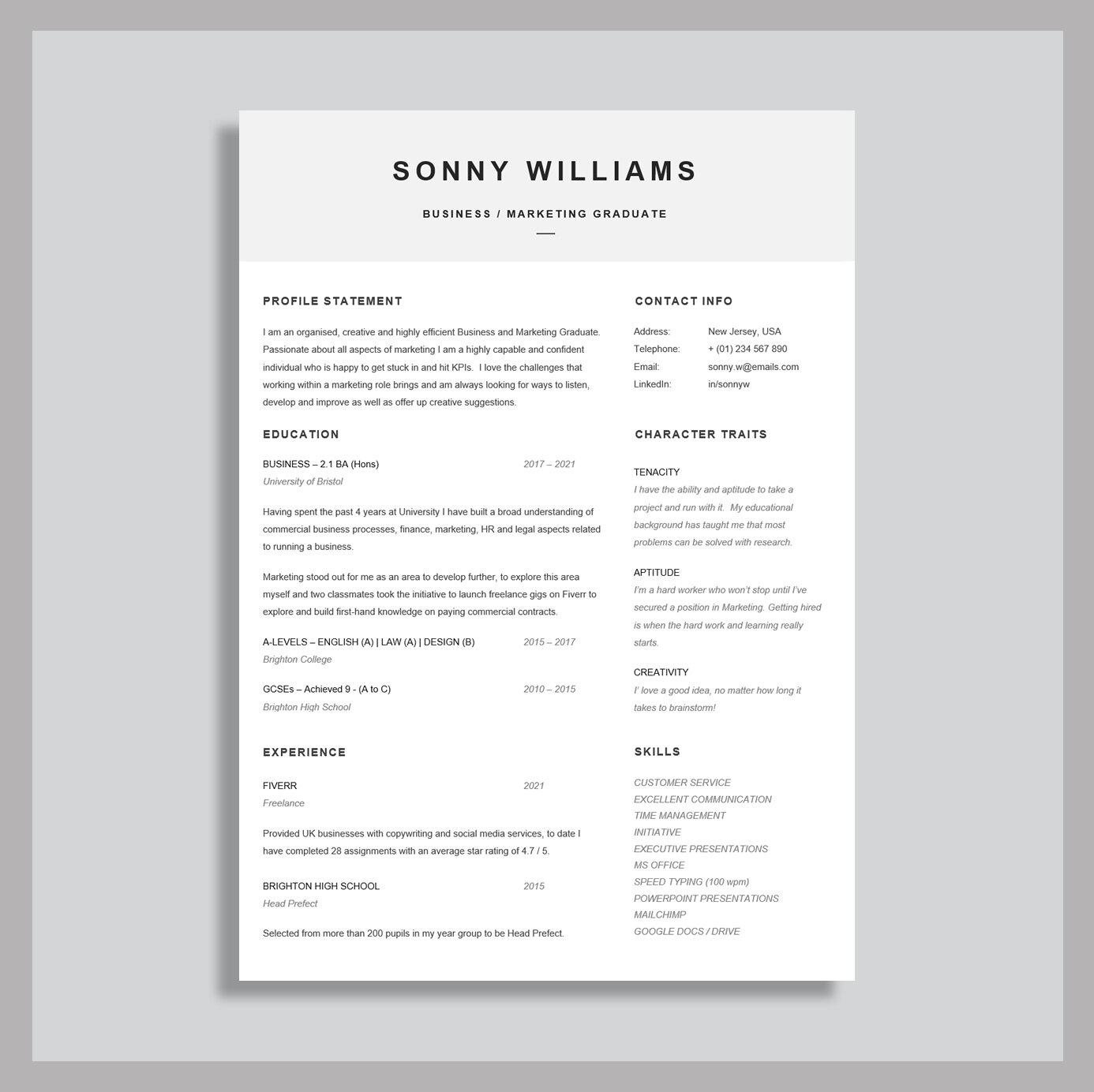
Writing a CV with no experience requires a slightly different approach. With limited employment history to rely on, you'll usually need to give more prominence to your education, projects, transferable skills, volunteering and profile.
Our free No Experience CV Template is designed for school leavers, students, graduates and anyone preparing their first CV.
12. Browse All CV Templates
If you would prefer more choice, our full CV template collection includes professional, modern, simple, creative and student designs.
Every template is designed to be edited, so you can change the content, sections and formatting to suit your experience rather than being locked into a fixed layout.
You can compare the different styles and choose the design that works best for your career, experience and target roles.
CV Template FAQs
What is the best CV template?
For most jobseekers, a clean reverse chronological CV is a strong starting point. Your most recent experience appears first, the structure is familiar to recruiters and relevant information is usually easy to find.
The visual style can still vary considerably, so the best template is one that presents your own experience clearly and suits the type of role you are targeting.
Should a CV be one page or two pages?
There is no rule that every CV must be one or two pages. One page can work well for students, graduates and people with limited experience. Two pages is completely normal for experienced professionals.
Use enough space to present relevant information properly without padding the document or removing useful evidence simply to reach a particular page count.
Are CV templates and resume templates the same thing?
For most job applications, yes. In the UK the document is normally called a CV, while employers in countries such as the US more commonly use the term resume. There are differences in conventions between countries, but downloadable CV and resume templates generally serve the same purpose, presenting your skills, experience and qualifications clearly to an employer.
Can I edit a CV template in Microsoft Word?
For those downloaded from the Career Improvement Club all are editable in MS Word, Pages and Google. For those downloaded via other platform check individually, many do not support MS Word, specifically creative platforms such as online CV creators and Canva.
Is a one column or two column CV better?
Neither is automatically better. A one column CV provides a very straightforward reading order and is a sensible choice if you want to keep formatting as simple as possible.
A well designed two column CV can organise supporting information such as skills, qualifications and contact details efficiently while leaving the main column for experience.
Are CV templates ATS friendly?
Yes almost certainly. Good practice regardless is to create a CV with clear section headings, selectable text, consistent dates and a logical structure. Avoid putting important information inside images, charts or decorative graphics.
If you are particularly concerned about compatibility with recruitment systems, a simple one column layout is the more conservative option.
Should I send my CV as a Word document or PDF?
Follow the instructions in the job advert first. If the employer asks for a particular file format, use it. PDF is useful because it normally preserves the appearance of your CV, while a Word document may be requested by recruiters or application systems.
It is worth keeping an editable Word version even if you normally send your applications as PDFs.
Can I use the same CV template for every job?
Usually, yes. You do not need a completely different design for every application.
What should change is the content. Your profile, achievements, skills and emphasis should be adjusted where necessary to reflect the role you are applying for.
Are creative CV templates a bad idea?
Not necessarily. Creative layouts can work well in areas such as design, branding, content, marketing and other roles where visual communication is relevant.
For more traditional or highly regulated industries, I would normally lean towards a professional or simple design. If you are unsure, choose the more restrained option.
Do employers care which CV template I use?
Employers are unlikely to know you’ve used a template, what matters most is whether your CV is relevant and easy to understand.
A strong design can improve presentation, but it cannot compensate for vague achievements, irrelevant information or a CV that has not been tailored to the role.
Ready to create yours? Browse all CV templates and find a layout that suits your career →
Article updated: 17 September 2026