
Artificial intelligence is reshaping industries today, making career choices more challenging than ever. A CBS News article explains the situation with numbers, stating that 50-55% of U.S. jobs will be reshaped by AI over the next three years. According to Boston Consulting Group’s managing director and senior partner Matthew Kropp, "What people do in these jobs will be different, even if the job is still there.”
In this dynamic environment, choosing a future-proof career is not about predicting a single “safe” job. Rather, it is about building adaptability, relevance, and resilience. While there are no shortcuts or clear roadmaps, a strategic approach can help you choose wisely.
In this article, we will share a few practical strategies to help you make informed career decisions in the age of AI.
## QUICK ANSWER
**To choose a future-proof career in the AI era:**
Match your interests with real market demand
Look for careers with a strong human core
Assess the tasks inside the job, not just the job title
Build transferable skills that work across industries
Learn how AI is changing your target sector
Commit to continuous learning and regular upskilling
#1 Match Interests to Market Needs
According to Indeed, choosing the right career path can help you achieve a sense of purpose and fulfillment professionally. By identifying your areas of interest early, you can choose a career that enables you to achieve your professional goals. A sustainable career is one that blends your interests with market needs.
While passion can keep you going, you must also consider real-world demand to ensure long-term viability. This alignment increases both job satisfaction and financial stability over time. For example, an interest in design can translate into high-demand areas such as UX/UI design, digital product development, or human-centered AI interfaces.
Research job trends regularly using credible platforms, checking industries experiencing growth, such as healthcare technology, renewable energy, cybersecurity, and data science. Evaluate how your natural inclinations can align with these areas. Rather than following trends blindly, aim to position your interests within them.
ACTIONABLE TIP:
Before choosing a career path:
Search for 10 to 20 current job adverts in that field
Note the skills employers keep repeating
Look for signs of long-term demand
Ask whether the skills can transfer into related roles later
👉 If you want more insight into skills, this guide explains what skills you should be including in your CV
#2 Look for the "Un-Automatable" Core
AI excels at repetitive, data-driven, and rule-based tasks, but it still struggles with deeply human capabilities. There are certain roles it can never take over. Careers that rely on creativity, empathy, ethical judgment, leadership, and complex problem-solving are less likely to be fully automated.
For example, while AI can assist in medical diagnosis, the human elements of patient care, communication, and ethical decision-making remain irreplaceable. Similarly, school counselors need to understand the mindset of young students, which AI cannot do. According to St. Bonaventure University, the number of students who need counseling services will increase in the future.
Many aspiring professionals are already pursuing school guidance counselor degree programs to enter the field. You can enrol if you are already an educator and want to transition to a counseling role. When evaluating career paths, ask what part of this job requires distinctly human judgment. Focus on roles where technology acts as an enhancer rather than a replacement.
ACTIONABLE TIP:
When assessing a career, ask:
Does this role require empathy or trust?
Does it involve judgement in complex situations?
Does it require communication with people who need support, advice or leadership?
Would AI support the work, or replace most of the work?
If the answer leans towards judgement, trust and context, the role may be more resilient.
#3 Consolidate Transferable Skills
A Forbes article highlights that the future of hiring is about transferable skills, which means they can add value to your resume. As industries shift, these skills enable employees to pivot and solve problems. For this reason, businesses consider them a plus when hiring people for their teams, even in the AI age.
Transferable skills are your safety net in a rapidly changing job market. These include communication, critical thinking, adaptability, collaboration, and digital literacy. For instance, someone skilled in project management can transition from construction to IT or healthcare with relative ease.
Similarly, strong communication skills are valuable in marketing, leadership, education, and consulting. Build a portfolio of such skills intentionally. Be open to diverse experiences, collaborate across disciplines, and practice applying your abilities in different contexts. This flexibility allows you to adapt for long-term career resilience.
ACTIONABLE TIP:
Take a job description and split it into three columns:
Tasks AI could probably automate
Tasks AI could help with
Tasks that still need human judgement
The strongest career paths are usually the ones where the third column still matters.
👉 If you are weighing up a career change, this guide explains how to access the hidden job market and find roles before they are advertised
#4 Commit to Continuous Learning
According to a Gallup survey, 72% of Fortune 500 CHROs say that AI will start replacing roles in their organization soon. For companies, this translates into a growing demand for new skills. The only way to address the gap is by upskilling the workforce. For professionals, this indicates the need for a commitment to continuous learning.
In the AI era, education does not end with a college degree. As technologies evolve rapidly, ongoing learning becomes the key to relevance. This does not always mean formal education. You may consider online courses, certifications, workshops, and self-directed projects to stay ahead of market trends.
Adopting a mindset of curiosity and adaptability is equally important. For example, a marketing professional today benefits from learning data analytics and AI-driven tools, while a healthcare worker may need to understand digital health platforms. Set aside regular time for skill development and invest in continuous learning to enhance your employability.
ACTIONABLE TIP:
Create a simple three month learning plan:
One technical skill
One human skill
One industry knowledge area
This keeps your development focused and stops you collecting random courses without a clear career direction.
#5 Build AI Literacy Without Becoming a Developer
You do not need to become a software engineer to stay relevant in the AI era. But you do need to understand how AI is changing the work you want to do.
AI literacy means knowing how to use AI tools responsibly, question their output and combine them with your own judgement. For a marketer, that might mean using AI for research, planning and first drafts. For a healthcare worker, it might mean understanding digital health platforms. For an administrator, it might mean learning how automation affects reporting, scheduling or customer support.
The goal is not to compete with AI. The goal is to become someone who can use it well.
ACTIONABLE TIP:
Pick one AI tool relevant to your sector and learn how to use it for:
Research
Planning
Drafting
Analysis
Productivity
Then practise improving the output rather than accepting it as finished.
FAQs
1: Which jobs will soon be replaced by AI?
Jobs like data entry clerks, basic customer support roles, telemarketing, and routine manufacturing jobs are at high risk. AI can efficiently handle structured processes, reducing human involvement. Roles requiring creativity, empathy, and complex decision-making are relatively safer.
2: Why is professional networking important today?
Professional networking helps you stay informed about industry trends, discover hidden job opportunities, and gain insights from experienced individuals. In a fast-changing job market, connections often provide early access to opportunities and guidance. Networking also builds your personal brand, making you more visible and adaptable in competitive environments.
3: How to upskill to match the market needs?
Start by identifying in-demand skills in your chosen field through job listings and industry reports. Enroll in online courses, attend workshops, and work on practical projects. Focus on both technical and soft skills. Consistency matters more than intensity, so dedicate regular time to learning and applying new knowledge effectively.
Key Takeaways
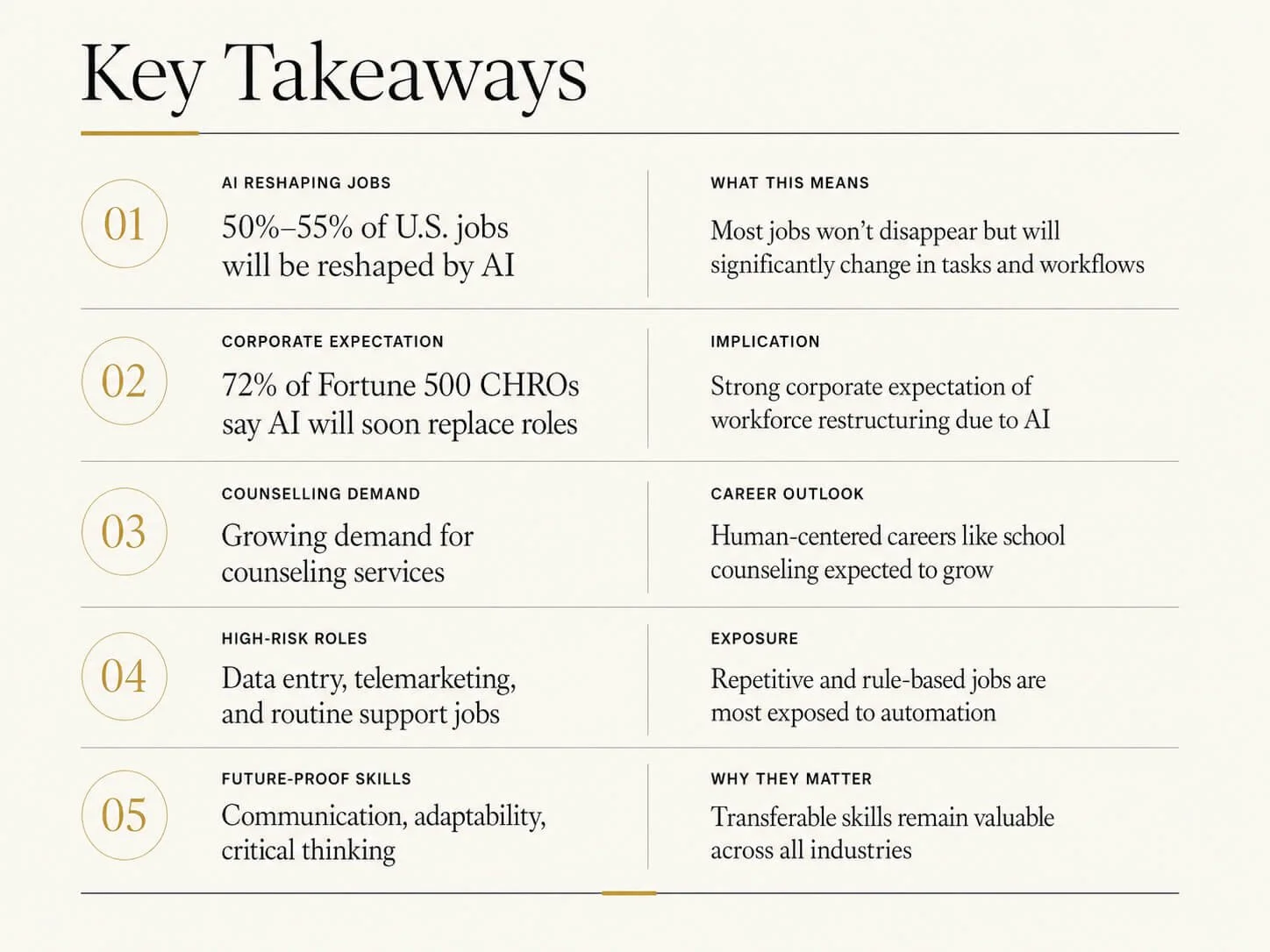
Choosing a future-proof career in the AI era requires a balance of self-awareness, market understanding, and adaptability. Rather than chasing certainty, focus on building a flexible foundation of skills and knowledge that can evolve with time. Align your interests with growing industries, strengthen uniquely human abilities, and commit to continuous learning. By doing so, you position yourself not just to survive technological disruption, but to thrive within it. The future of work belongs to those who are prepared to grow, adapt, and innovate alongside advancing technologies.