Most professionals assume that working hard and acquiring years of experience are enough to get senior leadership roles. But this industry believes in the power of numbers.
40% of stressed leaders have considered leaving leadership roles due to well-being concerns. It shows how demanding leadership has become. Success at senior levels requires more than experience alone. Leaders must develop strategic thinking, decision-making, adaptability, and people-management skills to navigate increasingly complex business environments.
Meanwhile, another report found that the lack of employee engagement costs the global economy $10 trillion in lost productivity annually. You can't ignore the gap between ambition and actual leadership capability.
Do you want to build leadership skills that last for decades, not just until the next promotion cycle? Modern leadership requires a strategic framework. It isn’t just one skill, one job thing. It needs business acumen, analytical thinking, and people management. It all starts with understanding what leadership actually demands at the highest level.
QUICK ANSWER
To build strategic leadership skills for long-term professional success, you need more than experience or hard work. Strong leaders develop business judgement, data literacy, emotional intelligence, systems thinking and the confidence to contribute visibly across an organisation.
To become a stronger strategic leader:
Invest in structured learning or leadership development
Improve your ability to interpret and use data
Build emotional intelligence before you move into higher pressure roles
Understand how decisions affect people, teams and business outcomes
Seek feedback from mentors, peers and senior colleagues
Take on projects that expose you to wider business challenges
Communicate ideas clearly to different stakeholders
Build visibility through useful contribution, not self-promotion
Treat leadership development as a long-term habit, not a one-off push
Invest in a Structured, Advanced Learning Program
Not all leaders continue to grow at the same pace. Those who keep advancing are usually willing to pursue formal, structured education when it matters most. Practical experience matters enormously. But it has limits. It teaches you what works in your context. Structured learning exposes you to frameworks, research, and cross-industry thinking. It enriches your perspective beyond the current horizons.
Professionals move into senior management and executive roles with skills and experience. During that transition, people realise that work experience isn’t going to save them alone. You need an advanced education that can help bridge that gap. A bridging course helps you with a better understanding of practical leadership strategies, data analytics and more.
Take, for instance, professionals who are targeting senior roles in business, technology, or consulting. A Doctorate of Business Administration online program provides a theoretical depth and practical application skills that experiential learning alone cannot provide.
Marymount University encourages exploring online programs to build real-world experiences while keeping up with academics. There are endless possibilities in the world of business intelligence, data-driven decision-making, and leadership lessons. This is exactly what separates candidates at the executive level and helps them become confident corporate leaders tomorrow.
👉 If you want a structured way to plan your next professional step, the Career Development Plan Template helps you review your goals, identify skill gaps and build a clearer path towards long-term career growth.
ADDITIONAL INSIGHT
Structured learning gives leaders something that experience alone may not always provide: perspective. It exposes you to different industries, leadership models, research and ways of thinking that may not exist inside your current organisation.
This is especially useful for professionals moving from operational roles into strategic roles. The work changes from doing the task well to understanding the system, making better decisions and helping others perform at a higher level.
ACTIONABLE TIP
Before choosing a leadership programme, course or qualification, check whether it helps you build:
Strategic decision making
Financial or commercial understanding
Data and analytics confidence
People leadership
Change management
Communication with senior stakeholders
Real-world application through projects or case studies
The best leadership learning should help you perform better at work, not just add another credential to your CV.
Develop Data Literacy as a Core Leadership Competency
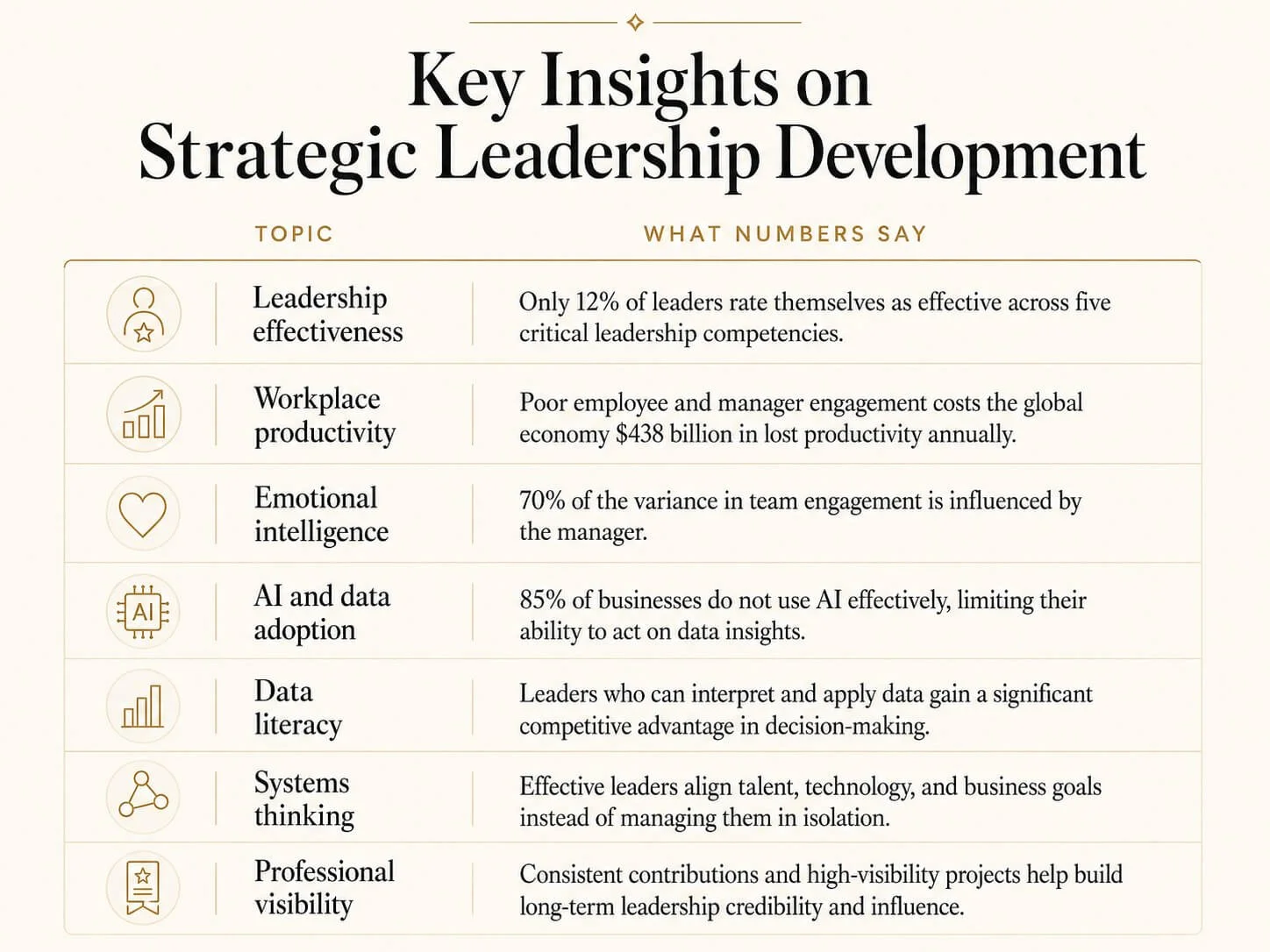
Strategic leaders must make decisions with precision, not just instinct. IBM's AI in Action report found that 85% of businesses do not use AI effectively. It means organizations are sitting on enormous amounts of data they cannot interpret or act on. Leaders who can close that gap hold a significant competitive advantage.
Data literacy does not mean you need to become a data scientist. It means you:
Need to understand data analytics
Question the data team about everything, and
Use evidence-based cases to make strategic decisions.
This skill set also directly strengthens your credibility with boards, investors, and cross-functional stakeholders. They increasingly expect leaders to back recommendations with numbers.
Start by taking on data-adjacent projects in your current role.
Volunteer to sit in on analytics reviews.
Pursue coursework that connects business strategy to business intelligence tools.
ADDITIONAL INSIGHT
Data literacy is becoming a leadership skill because senior decisions increasingly need evidence. Leaders do not need to analyse every spreadsheet themselves, but they do need to ask better questions.
A data literate leader can challenge assumptions, spot weak evidence, identify trends and use information to support a clearer recommendation.
ACTIONABLE TIP
In your next project or meeting, practise asking:
What does the data actually show?
What are we assuming?
What is missing?
How reliable is the source?
What decision does this information support?
What would change our conclusion?
This helps you move from passive data consumption to better strategic thinking.
Build Emotional Intelligence Before You Need It
Research consistently shows that emotional intelligence outperforms technical skill as a predictor of leadership success over the long term. Gallup's research confirms that 70% of the variance in team engagement comes down to the manager alone.
The way you communicate, handle conflict, and respond to pressure directly affects how your team performs. How you perceive feedback also plays a major role in employee engagement.
The problem is that most professionals only start working on emotional intelligence after a leadership failure has made the gap obvious. Building it proactively, through coaching, feedback loops, and structured reflection, is far more effective.
Find a mentor who will give you honest assessments, not only positive feedback to make you happy.
Join peer leadership groups where candid conversation is the norm.
Practice active listening in meetings by summarizing what others have said before offering your own perspective.
These habits compound over time.
ACTIONABLE TIP
Build emotional intelligence by creating a simple feedback habit.
After important meetings, ask yourself:
Did I listen properly?
Did I interrupt or dominate?
Did I understand the concern behind the words?
Did I respond calmly?
Did I make the next step clear?
Small improvements in these areas can have a major impact on how people experience your leadership.
Develop Systems-Thinking to Make Better Strategic Decisions
Leaders who build lasting careers develop the ability to see how decisions in one area ripple across an entire organization. Siloed thinking is one of the reasons mid-career professionals face failure. It is where a leader optimizes their own department at the expense of the broader business.
McKinsey's research on strategic workforce planning highlights that organizations perform best when talent decisions are closely aligned with business strategy and evolving capability needs. Developing this systems-thinking mindset requires leaders to understand how people, technology, and business goals interact across the organization.
Study how decisions upstream in your organization produce consequences downstream.
Map the stakeholders affected by major initiatives.
Make cross-functional collaboration a regular part of how you work, not an occasional exercise.
ACTIONABLE TIP
Before making a major recommendation, map the likely impact across:
Customers
Employees
Managers
Finance
Operations
Technology
Compliance
Long-term business goals
If a decision benefits one area but creates risk in several others, it may need more thought.
Prioritize Visibility Through Contribution
Strategic leadership is not just about what you know. It is about who sees you applying it. Seek out high-visibility projects where your analytical and decision-making skills will be on display. Present findings to senior leadership. Write internal memos that document your strategic thinking. Publish on professional platforms where your ideas can reach audiences beyond your organization.
Long-term professional success needs you to build a reputation that puts you at the forefront. That reputation is built through consistent, visible contribution over time, not through a single high-profile moment.
The leaders who advance farthest are not necessarily the most talented people in a room. They are the ones who combined structured learning with deliberate skill-building, invested in self-awareness, and stayed curious about the systems around them. Start with one habit from this list. Build it into your weekly routine. Treat leadership development as the long game it actually is.
👉 If you are preparing for a leadership interview, this guide shares smart questions to ask in a job interview, including questions about progression, development and long-term expectations.
Frequently Asked Questions
Why are strategic leadership skills important for long-term career growth?
Strategic leadership skills help professionals move beyond day-to-day execution and think at a higher business level. They improve decision-making, team alignment, and adaptability. Over time, these skills make leaders more effective in senior roles and better prepared to handle organizational change, growth, and complex business challenges.
How can I build strategic leadership skills without leaving my job?
You can build them through structured learning, data-focused projects, coaching, and cross-functional exposure. Take on responsibilities that require analysis, collaboration, and decision-making. Join leadership groups, seek honest feedback, and apply what you learn in your current role. Small, consistent habits create long-term leadership growth.
What is the fastest way to become a stronger strategic leader?
The fastest way is to combine learning with action. Strengthen your business knowledge, improve data literacy, and develop emotional intelligence. Then apply those skills in visible projects. Strategic leadership grows when you consistently connect ideas, people, and outcomes, not just when you collect experience.
What is the difference between leadership and strategic leadership?
Leadership often focuses on guiding people, managing work and helping teams perform. Strategic leadership goes further. It requires a broader understanding of business goals, market conditions, organisational priorities and long-term decision making. Strategic leaders connect people, data, systems and outcomes.
Can strategic leadership skills be learned?
Yes. Some people may have natural leadership strengths, but strategic leadership can be developed through structured learning, feedback, mentoring, cross-functional projects and deliberate practice. The key is to build both technical judgement and people skills over time.
What leadership skill should I develop first?
Start with self-awareness. If you do not understand your own strengths, gaps, communication style and pressure points, it becomes harder to lead others well. From there, focus on data literacy, decision making, emotional intelligence and strategic communication.
Key Insights on Strategic Leadership Development
Building strategic leadership skills is no longer optional for professionals who want lasting success. Experience matters, but it is not enough on its own.
Leaders who grow the farthest are the ones who keep learning, understand data, manage people well, think across systems, and stay visible through meaningful contribution. When leadership development becomes a long-term habit rather than a one-time push, career growth becomes far more intentional, resilient, and rewarding.
CLOSING INSIGHT
The strongest leaders are not simply the people with the most experience. They are the people who keep learning, adapt their thinking and understand how to create value through others.
Strategic leadership is built gradually. Every decision, conversation, project and piece of feedback gives you a chance to practise. The professionals who treat leadership as a long-term craft are usually the ones best prepared for senior responsibility.
👉 If you are ready to position yourself for your next leadership move, browse our CV templates and job search tools, including professional CV templates designed to help you present your experience with clarity and confidence.