

A lot of career advice assumes the same opportunities exist everywhere, but that’s rarely true. The jobs growing in your area may look very different from the jobs growing somewhere else.
That's why national rankings can only tell you so much. A career that looks promising on paper may have limited openings where you live. Another field might be hiring steadily but receive zero attention online.
Before you spend money on training or switch industries, look at what's happening in your local market. Hiring trends, workforce shortages, and employer demand can tell you where opportunities are building.
These signals often give you a clearer picture than broad career forecasts.
QUICK ANSWER
Your local job market can give you useful clues about your next career move. Instead of relying only on national “hot job” lists, look at what employers near you are actually hiring for, where shortages exist, and which industries continue to need people locally.
To use your local job market properly:
Look beyond national career rankings
Check local job boards, employer websites and workforce reports
Identify industries with repeated hiring demand
Pay attention to local skills shortages
Research whether training investments are being made in your area
Compare salary, commute, flexibility and progression opportunities
Speak to people already working in the sector locally
Avoid retraining for a career before checking whether local demand exists
Yesterday's Hot Job Market May Look Different Today
Many people choose a career based on what a region was known for 5 or 10 years ago, which can backfire. For instance, the Bay Area still has a strong connection to technology. Yet recent shifts in the job market show how quickly conditions can change.
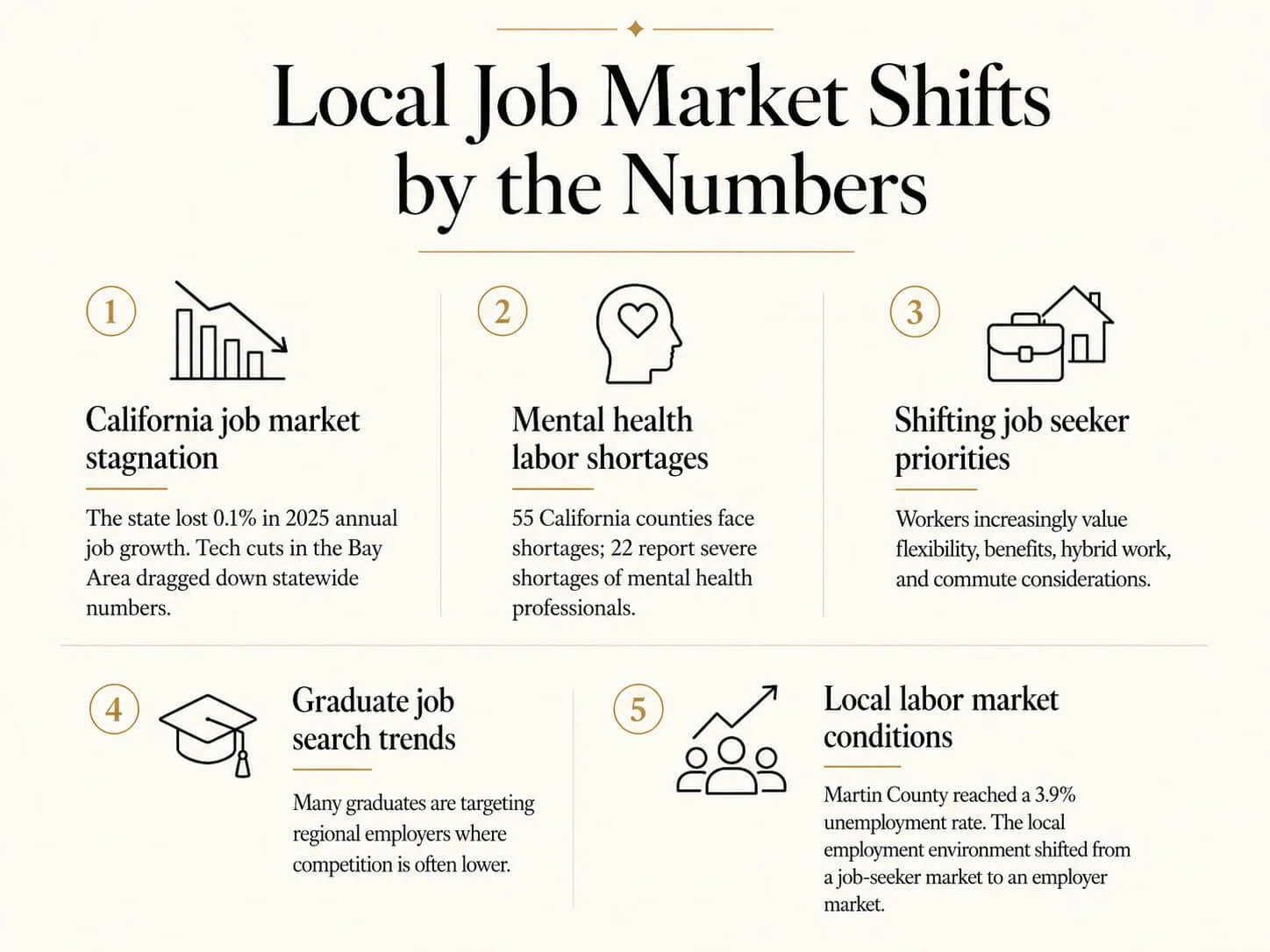
According to Mercury News, California's job market ranked among the weakest in the country for job growth. The state's job growth fell by 0.1% in 2025. Meanwhile, states such as Florida, Texas, New York, and Tennessee added jobs at a much faster pace.
Bay Area job losses continued to weigh on statewide hiring. California added roughly 20,000 government jobs during the year, but overall growth remained well below levels seen in several competing states.
These numbers matter if you're considering a career path. Check local job boards and review workforce reports. You should also talk with people working in the industry. A region's reputation may attract attention, but current hiring activity tells you much more.
ACTIONABLE TIP
Do not rely on a region’s old reputation.
Create a simple comparison between:
What the area is known for
What employers are hiring for now
Which sectors are growing
Which sectors appear to be cutting back
Which roles keep appearing across different sites
This helps you avoid choosing a career based on outdated assumptions.
Look Where Employers Are Struggling to Hire
Some of the strongest career opportunities appear when employers cannot find enough qualified workers. Sometimes the numbers make that clear. The Los Angeles Times noted that California's mental health workforce shortage extends across 55 of the state's 58 counties.
In 22 counties, the supply of mental health professionals falls at least 50% below demand. Los Angeles County also faces a notable gap. A recent $110 million initiative aims to support training, scholarships, and clinical experience for future social workers and counselors entering the field.
Those gaps create openings for trained professionals. If you're considering work in counseling, advocacy, or community support, pay attention to local workforce needs. Someone exploring those paths may look into an online social work degree in California.
University of the Pacific notes that students can complete coursework online while gaining supervised field experience. This preparation can help graduates enter fields where employers continue looking for qualified workers.
Investments of this size usually reflect existing workforce needs. Local shortages show you where demand persists.
ADDITIONAL INSIGHT
Shortages can be a strong signal, but they need to be understood properly. A shortage does not automatically mean every role is easy to get. It may still require qualifications, licences, experience or supervised training.
However, shortages often show where demand is persistent. If employers, public bodies or universities are investing in training routes, scholarships or workforce development, it usually means the need is not temporary.
ACTIONABLE TIP
When you spot a shortage area, ask:
What qualifications are required?
How long does training take?
Are there funded pathways, apprenticeships or scholarships?
Are employers actively recruiting entry-level candidates?
Is there clear progression after entry?
Does the work fit your strengths and lifestyle?
This helps you separate genuine opportunity from a career path that looks promising but may be difficult to enter.
Observe How Job Seekers Are Adapting
Worker behavior reveals the real direction of the local market, which is evident in Santa Clarita. Hometown Station found that many job seekers aren’t focused only on job titles and pay.
Schedule flexibility, benefits, commute times, and hybrid work options now carry more weight in career decisions. There’s also steady hiring across the city’s healthcare, education, skilled trades, logistics, hospitality, marketing, and customer service industries.
This shows that job seekers are weighing more factors than they did a few years ago. The same pattern appears among recent graduates. WBUR found that many graduates are moving away from large, well-known employers during their job search.
Career advisers are encouraging students to focus on regional companies where competition is often lower. Experts also point to healthcare as a bright spot. Employers continue to hire across a range of entry-level and support roles despite broader uncertainty in the job market.
When large groups of workers start building similar skills or changing their strategies, they're usually responding to conditions they see every day.
ACTIONABLE TIP
When comparing local opportunities, score each role across five areas:
Pay
Commute
Flexibility
Progression
Long-term demand
A role with a slightly lower salary may still be the better choice if it offers a shorter commute, stronger development, better flexibility and steady demand.
👉 If you want to find opportunities before they appear on the main job boards, this tool searches ATSs and lets you access the hidden job market.
Local Hiring Trends Often Tell a Different Story
Unemployment numbers matter, but they always require local context. Fairmont Sentinel noted that Martin County’s local labor force stood at 10,523 people, with an unemployment rate of 3.9%.
That matched Minnesota's statewide rate and sat slightly below the national rate of 4.3%. Amanda Blaschko, an analyst with the Minnesota Department of Employment and Economic Development, sees a different market than a few years ago.
She said it has shifted from “more of a job-seeker market” to “more of an employer market.” Businesses now have more leverage in hiring decisions than they had in recent years.
The demand for employment services has remained steady. Many workers are seeking help after layoffs, career disruptions, or job changes. Healthcare and truck driving remain key areas where employers continue to look for workers.
Similar patterns appear in many local markets. Some industries pull back while others continue hiring. That's why broad economic headlines rarely tell the whole story.
You need to understand which occupations remain active in your area. Local workforce reports and hiring trends can help. A career decision carries less risk when you understand where demand exists before you commit time and money to a new direction.
ACTIONABLE TIP
Look for patterns, not one-off job adverts.
If one employer is hiring, that may just be a vacancy. If several employers in the same area are hiring for similar roles, that could suggest wider demand.
Track roles that appear repeatedly over four weeks. Note:
Job title
Employer
Salary range
Required skills
Qualifications
Location
Remote or hybrid options
After a month, you will have a clearer picture of what your local market is really asking for.
People Also Ask:
How do you know if a career field has long-term potential?
A career field often shows long-term potential when employers continue hiring through different economic conditions. Look for consistent job postings, professional associations supporting the field, and ongoing investment in training programs. Industries that attract funding and talent usually have a stronger foundation for future growth.
Should you choose a career based on salary or job availability?
Both matter, but job availability deserves equal attention. A high-paying profession may not offer many openings in your area. Before committing to a career path, compare earning potential with hiring demand, competition levels, and advancement opportunities. A slightly lower salary can sometimes lead to better long-term stability.
What sectors offer the most stable jobs during economic transitions?
The healthcare and education fields remain stable because they solve deep local community shortages. However, these sectors often underpay. Massive public or private training investments also prove long-term regional hiring stability. Choosing paths with local licenses protects you from intense global competition on open job boards.
How often should I check my local job market?
If you are actively planning a career move, check your local job market weekly for at least a month. This gives you enough time to spot patterns rather than reacting to one or two adverts. If the same roles, employers or skills keep appearing, that is usually a stronger signal of demand.
Should I move location for better career opportunities?
Relocation can make sense if your target career has limited local demand but strong opportunities elsewhere. Before moving, compare salary, cost of living, career progression, commute, family commitments and quality of life. A better job market is only useful if the wider move works for your life.
Can remote work make local job markets less important?
Remote work can widen your options, but local markets still matter. Some sectors still require local licences, in-person experience, regional knowledge or occasional site visits. Even remote roles can be competitive nationally, so understanding both local and remote opportunities gives you a stronger strategy.
Local job market shifts by the numbers
Before You Make Your Next Move
Your local job market leaves clues, but most people simply don't look for them. Hiring trends, workforce shortages, training investments, and unemployment data can help you see where opportunities may be developing.
These signals won't guarantee success, but they can help you make a better decision. Before your next career move, spend some time studying the market around you. The answer is sitting in local hiring data rather than a national list of hot careers.
👉 If you are ready to present yourself more professionally, browse our CV templates and job search tools to create a clearer, better structured application for your next career move.