

So, you’ve found a job that you genuinely want. You’ve been back over it 2 maybe 3 times, this genuinely aligns! With each read you become more excited, more interested and more hopeful that maybe this is the one.
So you click submit CV, follow the application process and keep your fingers crossed that it reaches the right person.
or…
You can do a small amount of research to work out who the actual hiring manager is, and craft a direct outreach that gets you noticed.
Two very different methods to apply but when you genuinely align, the second option can have a big impact. Best of all, this approach is actually way easier than you might think.
QUICK ANSWER
To find the hiring manager for a job, start with the vacancy and identify the department, seniority and likely reporting line. Then search LinkedIn for employees at the company who sit roughly one level above the advertised role. You can also search LinkedIn posts or use our Find the Manager X-Ray search tool to do the heavy lifting for you.
The important bit is not simply finding someone at the company. It’s finding the person most likely to have some influence over this particular hire.
WHATS INCLUDED:
In this guide, we’ll cover:
What a hiring manager actually is
The difference between a hiring manager and a recruiter
How to identify the likely hiring manager from a job advert
A quick guide to likely reporting lines
How to find hiring managers on LinkedIn
How to search LinkedIn posts for clues
How Google X-Ray search works
A free way to automate the search
How to check whether you have found the right person
What to say when contacting a hiring manager
When you probably shouldn't contact them
Frequently asked questions
What Exactly Is a Hiring Manager?
What Exactly Is a Hiring Manager? So first up, let’s be clear, a hiring manager isn’t necessarily the recruiter.
External Recruiters or Internal Recruiters also known as Talent Attraction or Talent Acquisition Executives generally manage the recruitment process. They work at the front line of the recruitment process, taking the brief, advertising the vacancy, screening applications, arranging interviews and negotiating offers. This is their full time job.
The hiring manager is someone who is normally much closer to the actual role. They could be the person you will report to, the person responsible for the team or a senior manager (or company owner) with responsibility for making the appointment.
Recruiters and hiring managers work together, but their responsibilities are different. Recruiters tend to manage candidate sourcing and the recruitment process, while hiring managers are more closely involved with the role, its requirements and ultimately deciding who they want to employ (Indeed's guide to hiring managers and recruiters).
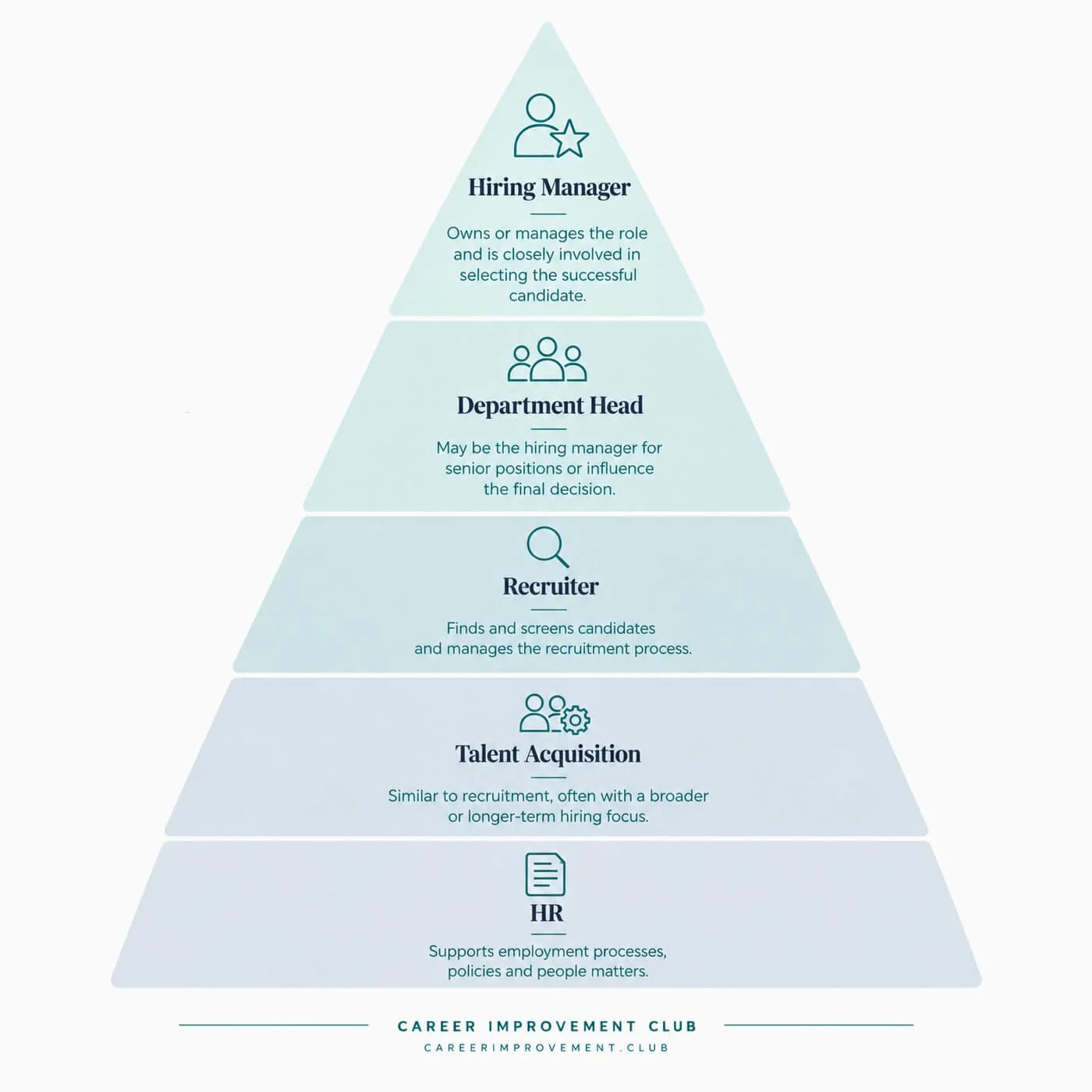
Think of it roughly like this:
Hiring Manager
Owns or manages the role and is closely involved in selecting the successful candidate.
Recruiter
Finds and screens candidates and manages the recruitment process.
Talent Acquisition
Similar to recruitment, often with a broader or longer-term hiring focus.
HR
Supports employment processes, policies and people matters.
Department Head
May be the hiring manager for senior positions or influence the final decision.
The distinction between the different roles matters. For example, if you're applying for a Marketing Manager position, searching LinkedIn for Recruiter at GOOD Company might find somebody involved in recruitment. But searching for Head of Marketing at GOOD Company could get you much closer to the person actually building the marketing team.
Neither is automatically the right person. So you still need to do a little detective work.
1. START WITH THE JOB ADVERT
Before disappearing down a LinkedIn rabbit hole, go back to the vacancy. There may be more information hiding in it than you realised. Look for phrases such as
"Reporting to the..."
"Working closely with..."
"Joining our X team..."
"Supporting the Head of..."
"You'll work alongside..."
"Part of the X department..."
Also note the location, department and seniority of the vacancy. If somebody is named in the advert, fantastic. Your job might already be done. If not, you're looking for enough information to make an educated guess about the organisational structure.
Who is this person likely to report to?
If I'm recruiting for a Marketing Executive, there's a reasonable chance that person reports into a Marketing Manager, Head of Marketing or someone similar.
For a Marketing Manager, I'm probably looking further up the structure.
For a Finance Manager, perhaps a Head of Finance or Finance Director.
You don't need the company's complete organisational chart. You just need to identify the handful of people who could realistically be responsible for this vacancy.
2. WORK OUT THE LIKELY HIRING MANAGER
Job titles vary enormously between organisations, so there is no universal formula. However, looking approximately one level above the vacancy and within the same function is the most sensible starting point.
3. SEARCH FOR THE HIRING MANAGER ON LINKEDIN
Once you have a couple of likely titles, head to LinkedIn.
You can search for people and then refine the results using filters including location, current company and keywords. Try searches along the lines of:
Head of Marketing + Company Name
or:
Marketing Director + Company Name
Then narrow the results to people currently working for the company.
You can also use Boolean searches. LinkedIn officially supports AND, OR, NOT, quotation marks for exact phrases and parentheses for grouping terms (LinkedIn's Boolean search guidance).
For example:
("Head of Marketing" OR "Marketing Director") AND "Company Name"
But, don't become obsessed with constructing the world's most complicated Boolean string. You're looking for a person, not trying to crack the Enigma code.
Do I need LinkedIn Premium?
It can help but not necessarily.
LinkedIn's Basic account includes people search, although there are limitations compared with Premium accounts. LinkedIn says free members can access basic filters and up to 250 results per search, while features such as its Actively hiring people filter are Premium features (LinkedIn's free and Premium search comparison).
There is also another route.
4. USE FIND THE HIRING MANAGER X-RAY SEARCH TOOL
Here's where things get slightly more interesting. As the best way to search LinkedIn isn’t actually in LinkedIn at all.
The Find the Hiring Manager tool uses LinkedIn X Ray search to look for publicly indexed LinkedIn profiles matching the company, role and location you enter. It can help uncover likely hiring managers, department heads, senior decision makers and recruitment contacts, without requiring LinkedIn Premium.
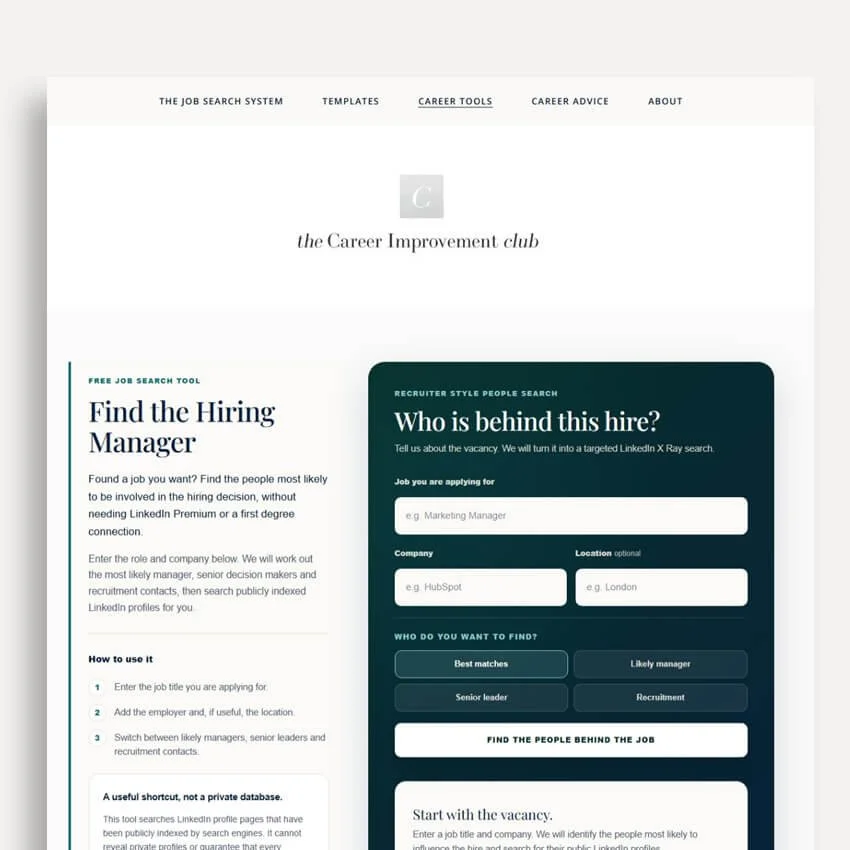
It bypasses normal LinkedIn restrictions allowing you to view profiles way beyond your connections without the need for any premium subscriptions either.
In technical terms it uses Google's site: search operator allowing the restriction of search results to a particular website or domain, while quotation marks can be used to look for exact phrases (Google's search operator guidance).
That means you can ask Google to look specifically for publicly indexed LinkedIn profiles.
For example:
site:linkedin.com/in/ "Acme Ltd" "Head of Marketing"
Or broaden it:
site:linkedin.com/in/ "Acme Ltd" ("Head of Marketing" OR "Marketing Director")
You're effectively saying:
Show me publicly indexed LinkedIn profile pages containing this company and these likely job titles.
This technique is generally known as X-Ray searching. Recruiters and sourcers have used variations of X-Ray and Boolean searching for years to find relevant people.
For a jobseeker, you're simply turning the technique around. Instead of a recruiter searching for somebody who could do the job, you're searching for somebody who could be hiring for it.
5. MORE ABOUT THE FREE X-RAY SEARCH TOOL
So, I created this free Find the Hiring Manager search tool off the back of a consistent candidate frustration, on a day-to-day basis I speak with a lot of candidates, many of which struggle with job search overwhelm, this tool is just one of a collection of tools, ebooks and services I offer to help make the process easier, more efficient and actually rewarding. Changing jobs should feel rewarding.
So how does it work?
Enter:
The job you're applying for
The company
A location, if useful
It then works out the types of people most likely to be involved in that hiring decision and creates a targeted LinkedIn X-Ray search.
You can choose to look specifically for:
Best matches
Likely hiring managers
Senior leaders
Recruitment contacts
There is no payment required and you don't need LinkedIn Premium to use the tool.
Find the Hiring Manager – Free Search Tool
The tool doesn't claim to know the company's internal reporting structure. It gives you a much faster way to identify the people most likely to be involved, using the information available publicly.
6. HOW DO YOU KNOW WHEN YOU HAVE FOUND THE RIGHT PERSON?
Finding a profile with a plausible job title is the first step, once you have someone you think is a good fit spend 1-2 minutes more just double checking…
Do they currently work there?
LinkedIn profiles aren't always completely up to date.
Are they in the right location?
A global company might have five Heads of Marketing covering completely different markets.
Does their role cover the right function?
"Director" sounds senior, but a Finance Director probably isn't hiring your next UX Designer.
Have they posted about the vacancy?
This is one of the strongest clues.
Have they mentioned growing the team?
Again, useful evidence.
Does the reporting structure make sense?
Look at other employees in the same department and piece the structure together.
You don't necessarily need absolute certainty. But you should have a reasonable basis for thinking this person could be relevant before appearing in their inbox.
Even if you take a guess and get it wrong, a well constructed email or LinkedIn outreach may well result in the person pointing you in the right direction.
7. SHOULD YOU CONTACT THE HIRING MANAGER?
Now, if you follow LinkedIn like I do, you'll know there are differing opinions on what I'm about to say.
Plenty of recruiters will tell you not to contact the hiring manager. And, to an extent, I understand why. Recruiters want to manage the recruitment process and, particularly where an external agency is involved, they don't want candidates bypassing them or muddying the waters.
But I'm in my mid-40s and I've worked in recruitment for pretty much my entire career. I've seen first-hand just how effective a well-timed cold approach can be.
So my answer is:
Yes, I think you should contact the hiring manager.
In most circumstances, I think you have considerably more to gain than you have to lose.
There is one important caveat. Treat contacting the hiring manager as a visibility and networking exercise, not a shortcut around the recruitment process.
You're not trying to jump the queue or persuade somebody to ignore everyone else. It's simply a professional nod that says:
"Hi. I'm here. I've applied. I'm genuinely interested, and my experience looks relevant."
That's why I'd normally recommend applying through the proper channel first.
Once you've submitted your application, you have a perfectly natural reason to introduce yourself. You're not asking a stranger how to apply or trying to circumvent the process; you're simply putting a person behind the CV that's just landed in their system.
What should you say?
Keep it short.
Keep it relevant.
And please don't send them your life story.
Something like this is more than enough:
Hi Sarah, I've just applied for your Marketing Manager vacancy. The focus on building organic acquisition particularly caught my attention, as that's something I've led for the past four years. I appreciate you're probably receiving plenty of applications, but I wanted to introduce myself directly. Richard
That's it.
No begging.
No enormous sales pitch.
No "I'm the perfect candidate and would like 30 minutes of your time to explain why."
And definitely no "Just checking you received my CV?" five minutes after applying.
You've simply connected something they need with something you can offer, demonstrated genuine interest and put your name in front of somebody who may be involved in the hiring decision.
Then let a strong CV do the heavier lifting.
The Bigger Point: Stop Treating a Job Application as a Single Click
Most job seekers once they click apply think that is the end of the process, next vacancy, but it isn’t, it’s really important to move away from that mindset and reimagine it as this is the first step.
Finding the right vacancy is actually quite hard, it might take days to come in. So grab the opportunity, submitting your CV is just the first part of a job search.
There is a bigger picture in play here.
Research the company, understand the team, work out the likely reporting structure, find relevant people, look at what they're talking about, tailor your CV properly and… where appropriate find the hiring manager and introduce yourself.
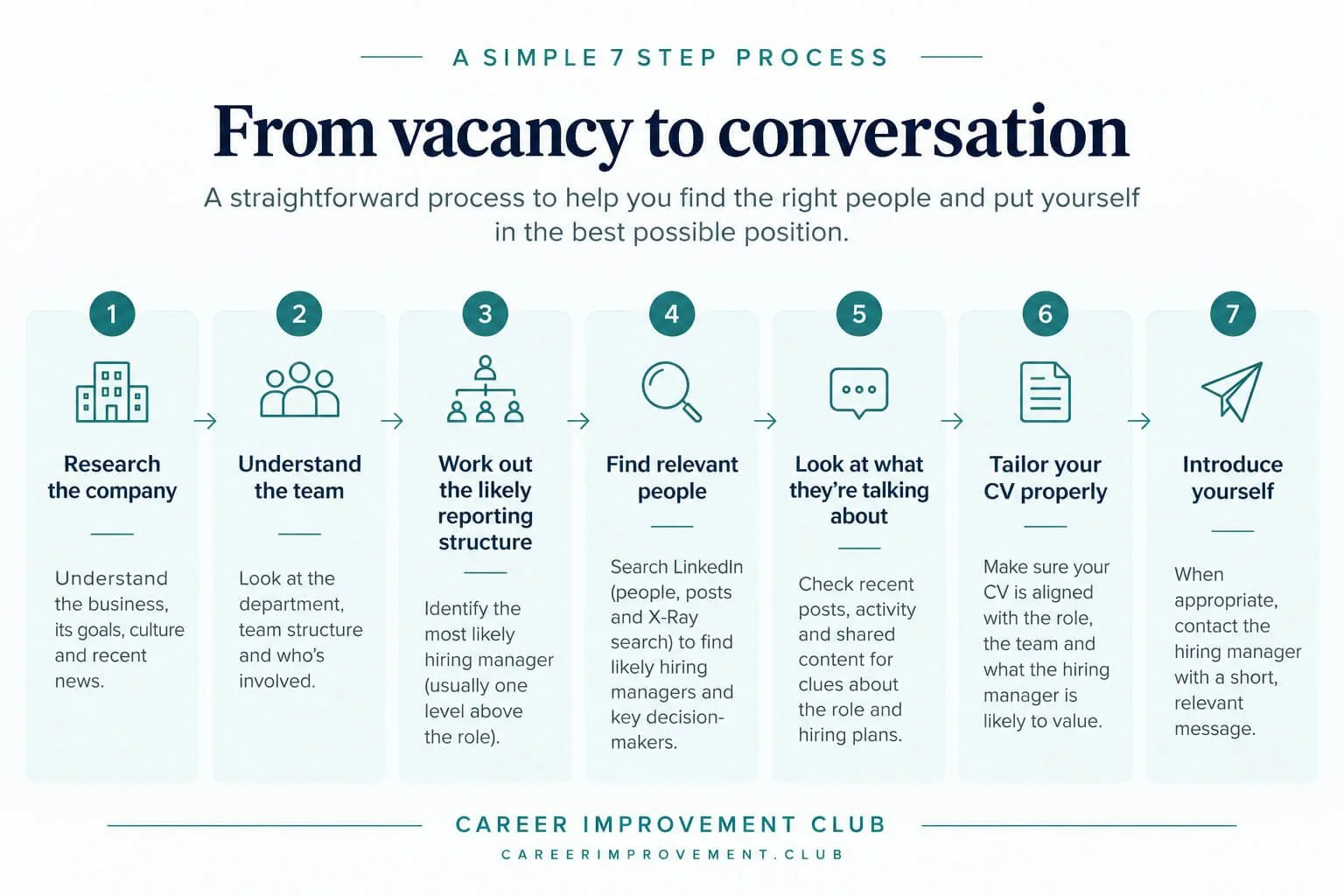
None of these things guarantees you an interview. But you're approaching the application with considerably more information than you had when you first spotted the vacancy. And likely more than other applicants.
A SIMPLE 10 MINUTE HIRING MANAGER SEARCH
Read the vacancy again and identify the department, seniority, location and any reporting clues.
Estimate the reporting line by looking approximately one level above the advertised position.
Search LinkedIn People for those likely titles at the company.
Search LinkedIn Posts for the vacancy title and company.
Run a Google X-Ray search to uncover relevant publicly indexed LinkedIn profiles.
Check your strongest matches against their current role, location and activity.
Choose one relevant person, rather than contacting everybody you can find.
Apply properly through the employer's requested route.
Send a short introduction if there is a sensible reason to do so.
Move on with your job search rather than waiting for a response.
Or, of course, skip quite a few of those searching steps: Find the Hiring Manager for Free
Other Useful Career Improvement Club Resources
You may also want to explore:
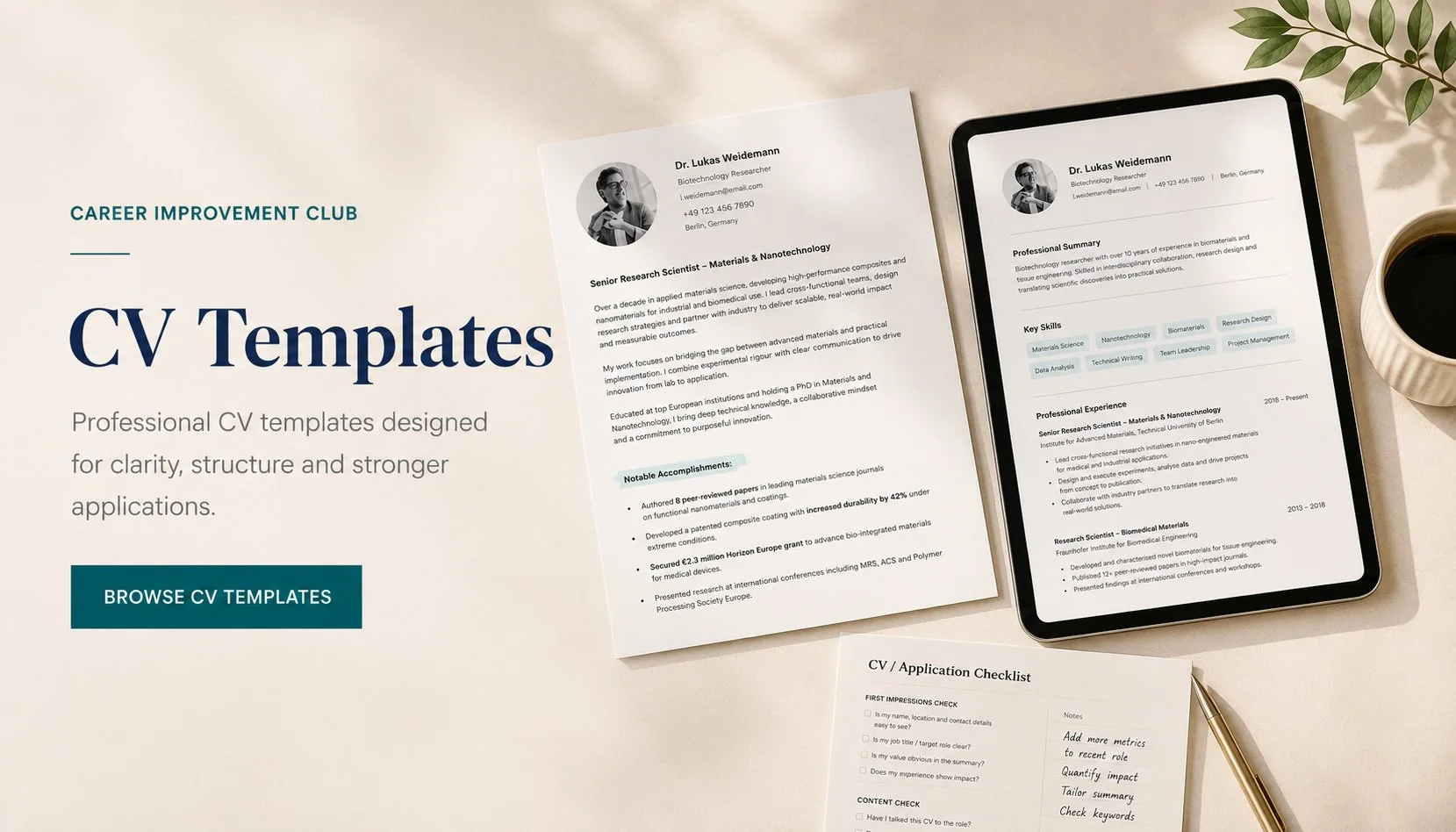
Career Improvement Club CV Templates — useful if your CV itself needs some attention before you start approaching employers. A good template can give you a professional starting point while allowing you to focus on tailoring the content to the vacancy.
Career Improvement Club Interview Presentation Templates — useful once all that detective work actually lands you the interview.
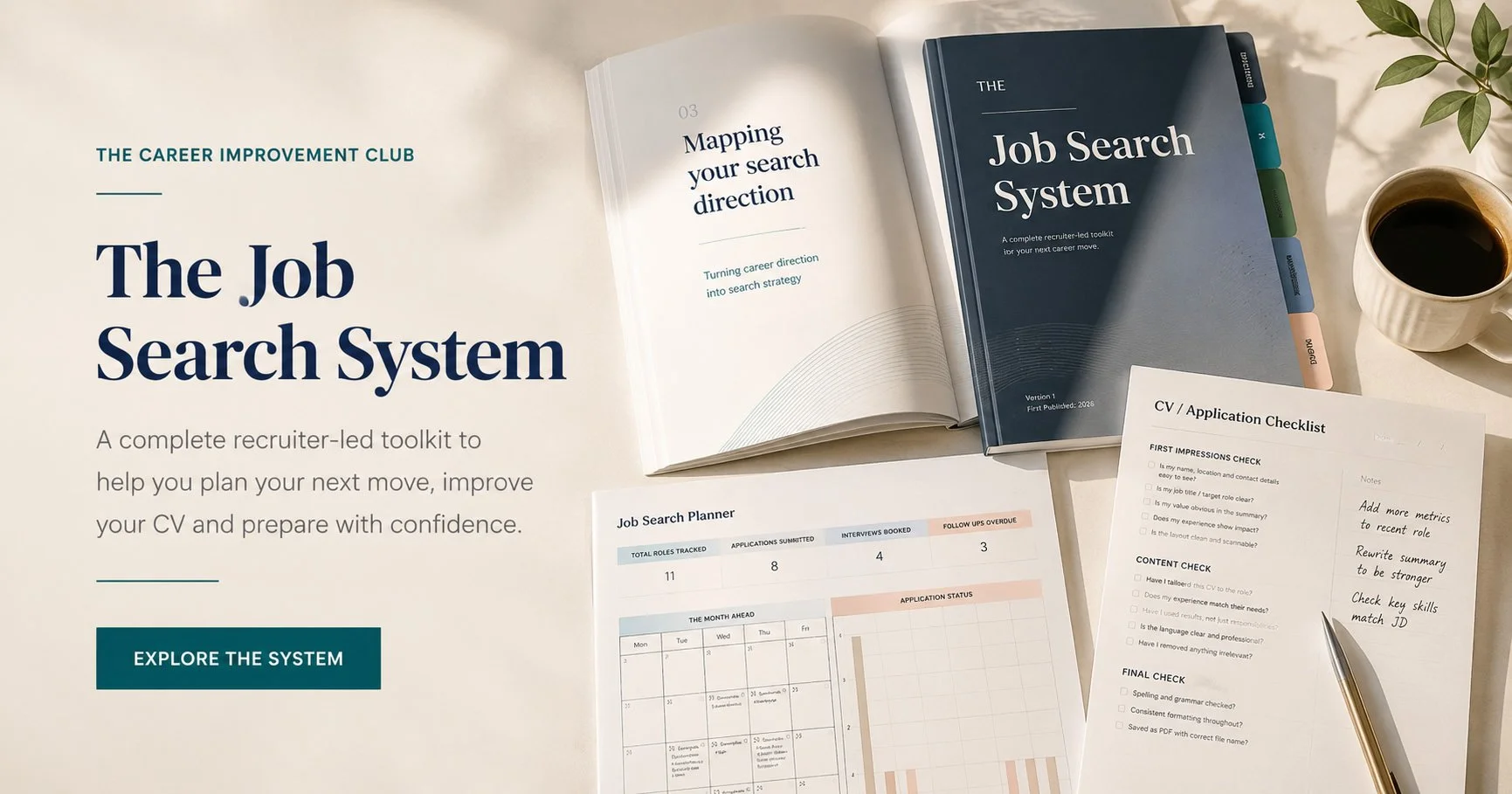
The Job Search System — for taking a more structured approach to finding, researching and pursuing opportunities rather than relying entirely on job boards.
Frequently Asked Questions
How do I find out who the hiring manager is for a job?
Start with the job advert and look for reporting lines, team names, named contacts and clues about the department. Then search LinkedIn for people at that company with relevant management titles, usually beginning around one level above the advertised role. Searching LinkedIn posts and Google-indexed LinkedIn profiles can reveal further clues.
Can I find a hiring manager without LinkedIn Premium?
Yes. LinkedIn provides people search to free members, although Premium accounts have additional features and filters. Google X-Ray search can also help you discover publicly indexed LinkedIn profiles. Alternatively, use the free Find the Hiring Manager tool.
Is the recruiter the same as the hiring manager?
Usually not. A recruiter typically manages parts of the recruitment process, while the hiring manager is more closely responsible for the vacancy, team and eventual appointment. They will often work together.
Should I contact the hiring manager before or after applying?
In most circumstances, I would apply first and then consider a brief introduction. That allows you to show genuine interest without asking the hiring manager to explain an application process that is already available to you. There are exceptions, particularly when you have a useful question that genuinely needs answering before applying.
What if I find several possible hiring managers?
Don't message all of them. Compare their job titles, locations, responsibilities and recent LinkedIn activity. Pick the person who appears most closely connected with the role. If you're still unsure, contacting the recruiter attached to the vacancy may be the safer option.
What should I say to a hiring manager on LinkedIn?
Keep your message short and specific. Mention that you've applied, identify the vacancy and briefly connect one piece of relevant experience to something important in the role. You're introducing yourself, not rewriting your cover letter inside a LinkedIn message.
Can I email the hiring manager directly?
If they provide a professional email address publicly for appropriate work-related contact, potentially. I wouldn't go hunting for personal email addresses or private contact information. LinkedIn or an official company contact route is normally more appropriate.
Does contacting the hiring manager improve your chances of getting an interview?
There is no guarantee. Think of direct contact as a way to improve visibility and establish a relevant professional connection rather than a way to bypass recruitment. Your suitability for the job, CV, experience and application still matter.
👉 If you are ready to update your applications for your next move, browse our CV templates and job search tools to create a clearer, more focused application.