
Isn’t it fascinating how mirages are real optical phenomena, yet they create images that easily deceive the viewer? A part of the reason has to do with human psychology. The brain is wired to assume that light always travels in straight lines.
Likewise, our brains naturally assume that the hiring process follows a clear path. However, many job seekers realise, much to their dismay, that the closer they get to the hiring process itself, the blurrier things become.
Known as the ‘hiring mirage,’ this phenomenon tends to be a double-edged sword. It can mislead both employers and job seekers. Johnny Campbell, CEO of SocialTalent, a hiring excellence platform based in Dublin, revealed the employer side of the dilemma.
He said, “The low hire, low fire environment that defined 2025 isn't temporary. It's the new baseline.” The hiring process may look open, accessible, and merit-based, but reality is veiled by risk and interpretation limits. No wonder even the best of candidates often fall for the mirage.
This article will guide you as a job aspirant, urging you to remember that the process often feels more certain than it really is. With that in mind, let's dispel the assumptions surrounding hiring through three ways in which the hiring mirage misleads the cream of the crop.
QUICK ANSWER
The hiring mirage happens when the job search looks fair, simple and merit based from the outside, but the real process is shaped by application volume, fast CV scanning, automated filters and unclear decision making.
To reduce its impact:
Make your CV instantly relevant to the role
Use clear language that both recruiters and systems can understand
Show outcomes, not just responsibilities
Keep your CV simple, readable and machine friendly
Apply through more than one channel
Follow up where possible
Remember that rejection is not always proof you were not good enough
👉 If you want a simple way to check whether your CV is doing this properly, this guide explains what skills to include in your CV.
Relevance Triumphs Over Capability on Paper
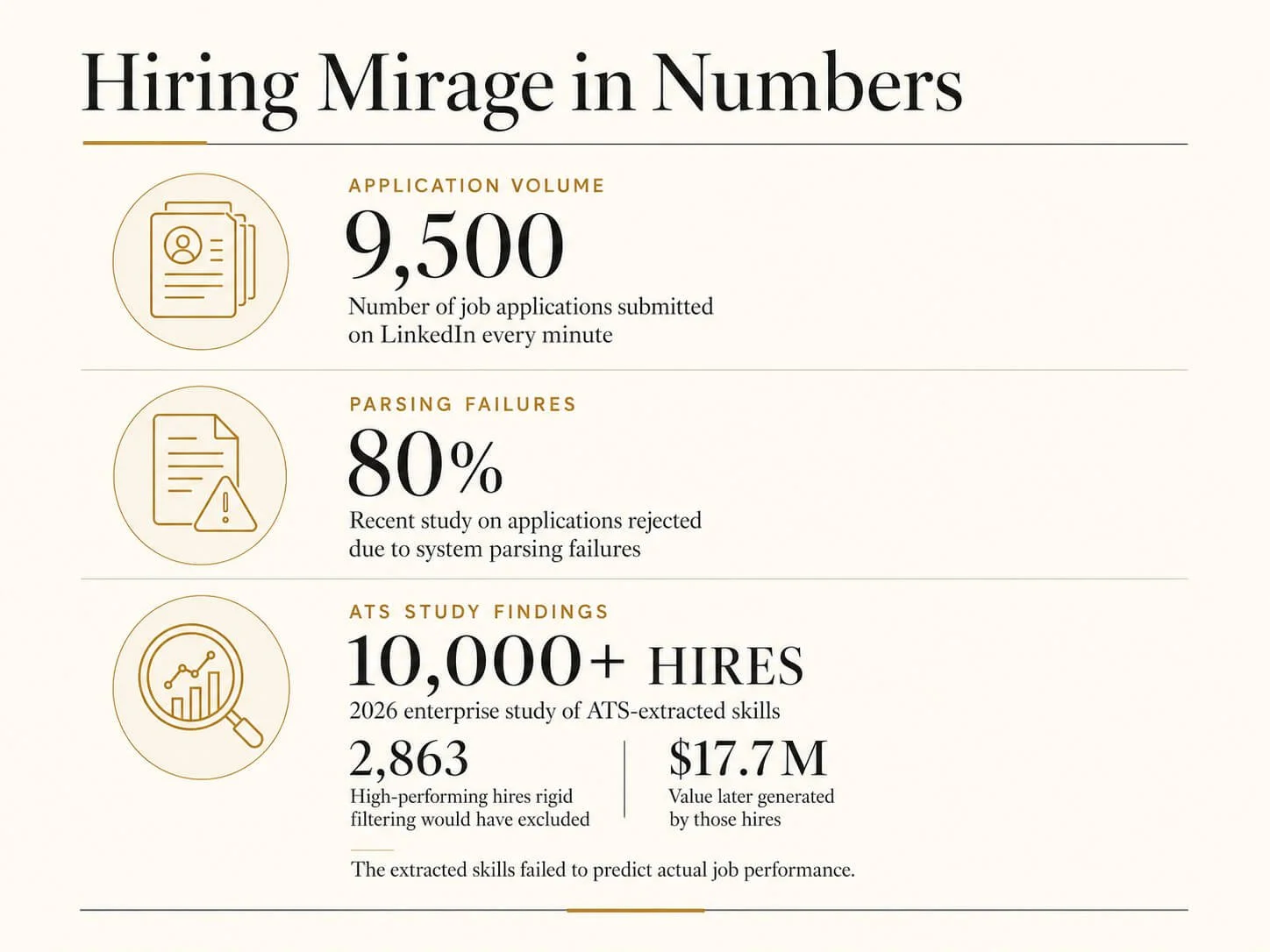
Towards the end of last year, CNBC published a rather fiery post. The title itself was intriguing: Recruiters are drinking through a fire hose of job applications. Well, given the fact that 9,500 applications are submitted on LinkedIn every minute, the title makes sense.
Kevin Dabulis, a talent acquisition expert with over three decades of experience, remarked on the sheer volume of job applications. He said, “Years ago, when you posted a job on the internet, you would get four or five decent resumes. Now each posting receives between 150 and 200 applications within the first 24 hours.”
If you were in a recruiter’s shoes, even 30 seconds for each resume would feel overwhelming after a while, right? Though the exact numbers may not be available, the truth is that most job applications’ fate is decided within seconds.
Many capable candidates equipped with top in-demand skills believe that good work speaks for itself, and in practice, it does. However, in a crowded pile of applications, the best of the work must be presented with clarity. No unnecessary details needed, just cut to the chase and prove relevance for the role applied for.
Basically, recruiters are not seeking to get to know each candidate deeply at this stage. Even at a glance, they want to know what stands out and whether that would prove to be relevant to what they are looking for. A person may be highly skilled and experienced, but if their value is not immediately visible, it risks never being seen at all.
NAVIGATING THE HIRING MIRAGE
Now that you can see through this mirage, what can be done? Here are some clear, actionable steps to take:
Do not merely list your previous roles and responsibilities. In a crisp and clear way, highlight what changed because of your role or responsibility.
Match your language to the job description without copying it as it is. An example would be using keywords from the job listing in your CV.
Design your CV for easy scanning, not storytelling. So, put the most relevant experience at the top and use short bullet points.
Take up the role of a ruthless editor. Cut out unnecessary details and avoid overly technical language.
Read your CV within 10 to 15 seconds and answer what job this person would be suitable for. If the answer is unclear, your resume needs to be simplified further.
ACTIONABLE TIP
Before applying, scan the job advert and highlight the top five requirements. Then check whether those five points are obvious in the first third of your CV.
If they are buried near the bottom, hidden inside long paragraphs or missing completely, the recruiter may never connect your experience to the role.
Complexity Tends to Get Lost in the Translation
Some candidates are highly skilled and also possess impressive experience. However, their complex data may get lost in the translation of systems designed to shortlist candidates based on quick interpretation.
Essentially, if something takes too long to understand, chances are that it will get overlooked. During the hiring process, experience should be instantly readable, not because depth is unimportant but because time is limited.
Here we see another layer of the hiring mirage appear. Candidates assume that strong experience speaks for itself. In reality, it could just be too complex to understand, and hence, be passed over. Healthcare professionals, especially nurses, are a solid example of this. Their training is often rigorous, and their learning continues long after formal education ends.
Nurses usually take up advanced courses to move into specialized roles. For instance, Rockhurst online nurse practitioner programs emphasize clinical experience through specialized coursework and patient-focused training. The online mode of learning offers the freedom needed to continue pursuing a career, as preparations to climb further are underway.
Candidates often must balance study, patient care, and professional development at the same time. Now, this requires significant focus and depth. Yet, condensing that journey into a few resume lines can make it difficult to understand that depth, let alone appreciate it. So, even strong professionals may appear less aligned.
NAVIGATING THE HIRING MIRAGE
If you have solid experience in your work repertoire, it would be unfair if it doesn’t shine before a recruiter, right? Let’s see ways in which you can prevent the hiring mirage from misleading you:
Clearly highlight your responsibilities, improvements, and results without assuming that employers automatically understand the significance of your experience.
Use plain language even when it comes to explaining specialized experience.
Connect the dots for the resume reader by drawing clear links between past experience and future potential.
Let employers know how additional certifications or learning have expanded your skills.
Include examples of projects or challenges that demonstrate the complexity of your previous work.
Request someone outside your field to review your resume to see whether they easily understand the value you can offer.
Use the “so what?” test on every important CV bullet.
If your CV says what you did, ask: so what changed because of it?
This helps you move from passive responsibility statements to stronger evidence based statements.
Example:
Weak: Responsible for onboarding new starters
Stronger: Improved onboarding process for new starters, reducing repeated questions and helping new team members become productive faster
A Significant Number of Applications Are Never Read By a Human
Earlier, we talked about the human perception problem due to the gargantuan volume of applications companies receive these days. This one goes to technologies like Applicant Tracking System (ATS).
Modern hiring is such that, and this is because of human limitations, almost all applications pass through AI-enabled systems for review and comparison. These systems are based on predefined filters and hold back applications before they reach a recruiter.
This means there is no real human judgment here in any sense. Only matching takes place, based on keywords, formatting, and certain predefined rules. If something does not align well enough, that application may never move forward, no matter how strong the candidate behind it is.
Studies have shown how fragile this stage can be. A recent study discovered that as many as 80% of applications are incorrectly rejected due to parsing failures. Just imagine the number of suitable candidates that get wiped out for no reason at all.
From the outside, the process feels like a fair evaluation. This is exactly where the illusion lies. You might wonder that you were not chosen, when in reality, you were never truly seen.
NAVIGATING THE HIRING MIRAGE
This one may seem largely out of your control, and it is. That’s exactly why you do not have to try to ‘defeat’ it. Instead, here are ways to increase your chances of being seen correctly:
Make your CV “machine-readable” by using simple fonts, avoiding tables or columns, and keeping standard section headings like Experience, Skills, etc.
Use keywords naturally, but avoid overstuffing them.
Steer clear of vague language for job titles, skills, and more.
Apply through multiple channels and follow up wherever possible.
Test your CV like a system by copying it into a plain text file and checking if it still reads clearly without formatting.
ADDITIONAL INSIGHT
This is why formatting matters more than many candidates realise. A visually impressive CV can still perform badly if the system cannot read it correctly.
Columns, tables, graphics, icons, text boxes and unusual section headings can all create problems for some systems. A CV does not need to look boring, but it does need to be readable after the design has been stripped away.
👉 If you are unsure how to balance design with readability, this guide explains how to build a stronger CV using templates.
FAQs
What does hiring mirage mean for job seekers?
In simple terms, hiring mirage refers to the disconnect between what the hiring process appears to be and what it actually is. Although job seekers assume the process to be fully transparent and merit-based, hiring decisions are often influenced by quick scanning and automated systems.
What causes qualified candidates to get rejected?
Qualified candidates may get rejected quickly because hiring today often relies on fast interpretation, not deep reviews. Recruiters may only spend seconds scanning a resume. Moreover, Applicant Tracking Systems often misunderstand solid experience due to predefined vetting standards.
How can job seekers avoid being affected by the hiring mirage?
Job seekers cannot fully eliminate the hiring mirage, but they can reduce its impact. It all starts with being aware of what this mirage is and how it works. Accordingly, creating a simple, machine-readable resume can help stand out before technology and humans.
Hiring Mirage in Numbers
Neither employers nor job seekers can expect the hiring mirage to disappear anytime soon. After all, it is built into the structure of modern hiring and will continue to exist in some form or another.
It helps to understand that the visible indicators of a potential good hire are often misleading, too. A large-scale 2026 enterprise study analyzed over 10,000 hires. It found that thousands of extracted ATS ‘skills’ failed to predict actual job performance.
Not only that, but the rigid filtering that happened due to those indicators would have excluded 2,863 high-performing hires who went on to generate $17.7 million in value. For employers, the takeaway here is not to rely too much on technology.
As for job aspirants, what appears to be rejection is not always a reflection of your ability or lack thereof. Perspective plays a crucial role here, and a major aspect of that is to overcome the hiring mirage. With this article, you should be able to walk through it without losing sight of your own value.