
Despite spending hours applying for positions, many job seekers still struggle to receive interview invitations or meaningful employer responses. Although the job market is competitive, common application and networking mistakes can quietly limit opportunities and reduce your overall chances of success.
Issues such as submitting generic applications, overlooking networking opportunities, or failing to tailor your resume can slow progress significantly. Recognizing these obstacles is an important step toward improving your search strategy and standing out to hiring managers.
In this article, we will examine six common job-search mistakes and share practical strategies to help improve results and increase opportunities.
QUICK ANSWER
If your job search feels slow, the problem may not be your experience. It may be your strategy. Many candidates reduce their chances by applying too broadly, using the same CV for every role, ignoring networking and failing to follow up properly.
To speed up your job search:
Target specific roles instead of applying for everything
Tailor your CV to each job description
Close obvious skill or qualification gaps
Keep your LinkedIn profile and online presence up to date
Use networking, referrals and direct company approaches, not just job boards
Follow up after applications and interviews
Track what is working, so you can improve your approach over time
👉 If you want a simple way to check whether your CV is doing this properly, this guide explains what skills to include in your CV.
1. Spraying Resumes Blindly Instead Of Targeting Specific Roles
Sending applications to every available opening may seem productive, but it often leads to lower-quality submissions. Tailored skills and relevant experience significantly increase your chances of receiving positive employer responses.
Focusing on positions that align with your qualifications allows you to tailor applications and improve your chances of securing interviews.
Career coach Steve Brady noted in a LinkedIn article that submitting 50 job applications a week does not constitute an effective job search strategy. The mistake of applying for every available job can reduce the quality of your applications and limit your chances of success. He emphasized that mass applications limit customization, while targeted, tailored applications can increase recruiter interest and improve interview opportunities.
ACTIONABLE TIP
Before applying for a role, ask yourself three quick questions:
Can I clearly show that I meet most of the key requirements?
Can I explain why this role makes sense as my next move?
Can I tailor my CV in less than 15 minutes because the fit is already strong?
If the answer is no to all three, the role may not be worth your time.
👉 If you want a smarter way to focus your search, this guide explains why your job search might not be working and how to fix it.
Overlooking Skill or Qualification Gaps
Many employers value candidates who show commitment to continuous professional growth beyond existing experience. Ignoring skill or qualification gaps can weaken career competitiveness in evolving industries. Hiring decisions increasingly depend on updated knowledge, expertise, and the ability to meet changing leadership expectations.
Ongoing training, certifications, and advanced academic credentials demonstrate initiative, adaptability, and readiness for greater responsibility. In education, leadership-focused doctoral studies build expertise in administration, policy, and instructional leadership. They also support organizational improvement and professional advancement.
Professionals in education leadership or training can strengthen long-term career growth through advanced qualifications. Online EdD programs can equip professionals with advanced leadership skills while supporting career progression.
Spalding University notes that the Doctor of Education in Leadership (EdD) prepares professionals to lead strategically, ethically, and with lasting impact. The interdisciplinary program promotes globally conscious leadership and transformative thinking. Courses are delivered one at a time, allowing working professionals to continue full-time employment while graduating.
ADDITIONAL INSIGHT
Skill gaps do not always mean you need a major qualification. Sometimes the missing piece is smaller and easier to fix.
It could be a software tool, a sector-specific keyword, a management skill, a short certification, or a clearer example of experience you already have but have not explained properly.
The key is to compare your CV against real job descriptions. If the same requirement appears again and again, and you cannot confidently show it, that is a gap worth addressing.
ACTIONABLE TIP
Review five job adverts for the type of role you want next.
Write down the skills, qualifications and experience that appear repeatedly. Then mark each one as:
Already strong
Needs better evidence
Needs development
This gives you a simple skills gap plan instead of a vague feeling that you are “not ready”.
👉 Understanding your career path can be one of the hardest parts of the job search, the following career development plan will help you unlock what roles work for you.
Using the Same Resume for Every Application
Submitting the same resume for every position can reduce your chances of attracting an employer’s attention. Different roles often require specific skills, experiences, and keywords that should be reflected in your application. Tailoring your resume to match each job description demonstrates effort and helps recruiters quickly identify your suitability for the role.
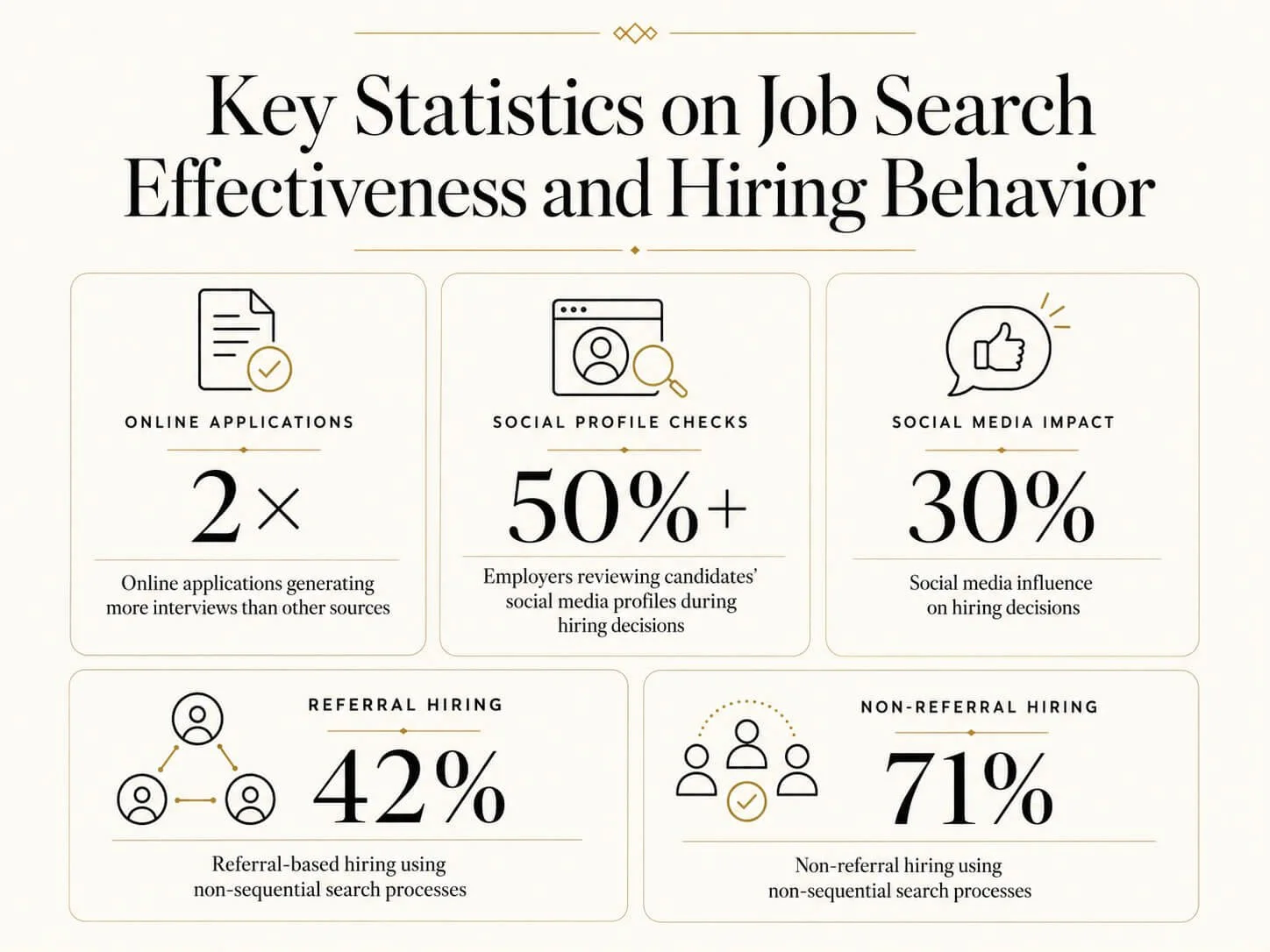
Using the same resume for every application can significantly slow down your job search and reduce interview chances. Glassdoor reported that in 2025, online applications generated twice as many interviews and 1.5 times more job offers than other sources combined. This highlights the importance of tailoring your resume effectively.
ACTIONABLE TIP
For each application, update these three areas first:
Your opening profile
Your key skills section
The first three bullets under your most relevant role
These are the areas most likely to be scanned first.
Neglecting Your Online Professional Presence
A strong online professional presence can support your job search and reinforce your qualifications. Recruiters frequently check professional profiles to evaluate candidates beyond standard resume details. Outdated information, incomplete profiles, or a lack of professional activity may create a weaker impression and reduce opportunities.
A study published on ResearchGate found that more than half of employers review candidates’ social media profiles when evaluating fit and professionalism. The study found that social media can affect hiring decisions by 30%, while conflicting content may seriously damage employment opportunities. The impact of neglecting your online professional presence is supported by recruitment research.
ACTIONABLE TIP
Before applying actively, check your LinkedIn profile for:
A clear headline
An up-to-date current role
Relevant skills
A simple summary of what you do
A professional profile photo
Experience that broadly matches your CV
This helps avoid unnecessary friction when recruiters look you up.
👉 If your LinkedIn profile is out of date, this guide shares practical LinkedIn profile tips for job seekers.
Relying Solely on Online Job Boards
Online job boards are valuable tools, but relying on them exclusively can limit your opportunities. Many positions are filled through referrals, networking, and direct connections before they receive widespread visibility.
Expanding your search strategy to include professional networking, industry events, and company career pages can increase your chances of finding suitable roles.
ScienceDirect research shows differences between referral and non-referral hiring processes. The study found that referral-based hiring was more efficient, with only 42% of searches being non-sequential compared to 71% for non-referral hires. It also required less time and resulted in lower hiring costs. This suggests that relying only on job boards limits efficient hiring exposure overall.
ADDITIONAL INSIGHT
Job boards are useful, but they are also crowded. By the time a role is advertised publicly, many other candidates are already applying.
That is why networking, referrals, direct approaches and company research matter. They help you get closer to opportunities before they become obvious to everyone else.
This does not mean awkward networking or begging for introductions. It can be as simple as reconnecting with old colleagues, following target companies, commenting thoughtfully on industry posts, or messaging people who work in roles you are interested in.
ACTIONABLE TIP
Create a target list of 20 companies you would genuinely like to work for.
Then, each week:
Follow two companies
Connect with two relevant people
Check their careers pages
Engage with one useful post
Send one polite message asking for insight, not a job
Small networking habits can uncover opportunities that never reach the main job boards.
👉 If you want to find opportunities before they appear on job boards, this guide explains how to access the hidden job market.
Ignoring the Importance of Follow-Ups
Following up after submitting a job application or attending an interview is often an overlooked but important step in the hiring process. Many candidates assume that their application alone is enough to stand out, but recruiters frequently receive hundreds of submissions for a single role. A well-timed follow-up message can reinforce interest, demonstrate professionalism, and keep a candidate top of mind.
It also shows strong communication skills and genuine enthusiasm for the position. In some cases, hiring managers interpret follow-ups as a sign of seriousness and attention to detail. Ignoring this step may result in missed opportunities, even when a candidate is well qualified for the role.
ADDITIONAL INSIGHT
A follow-up message will not rescue a poor application, but it can strengthen a good one.
It shows interest, professionalism and communication skills. It also gives you another opportunity to remind the employer why you are relevant.
The best follow-ups are short, polite and specific. They should not sound desperate or demanding.
ACTIONABLE TIP
Use this simple structure:
Thank them for considering your application
Reconfirm your interest in the role
Mention one reason you are a strong fit
Keep it brief
Example:
Hi [Name], I just wanted to follow up on my application for the [Role Title] position. I’m still very interested in the opportunity, particularly because of the focus on [specific area]. My experience in [relevant skill or achievement] feels closely aligned, and I’d welcome the chance to discuss the role further.
Frequently Asked Questions
Why do some applications never receive a response?
Many applications go unanswered due to high competition, automated filtering systems, or missing keywords that match job descriptions. Recruiters struggle to review every application when single roles attract hundreds of candidates. Incomplete profiles or generic resumes also reduce visibility.
How can I identify legitimate job opportunities online?
Legitimate job opportunities usually come from verified company websites, trusted job boards, or official LinkedIn pages. Check for clear job descriptions, company details, and contact information. Be cautious of vague postings, unrealistic salaries, or requests for upfront payments, which often indicate scams.
What key attributes do recruiters look for during initial screenings?
Recruiters first look for relevant skills, experience, and keywords that match the job description. They also assess resume clarity, formatting, and career progression. Strong alignment with role requirements and demonstrated achievements help candidates stand out during the initial screening process.
How many jobs should I apply for each week?
There is no perfect number, but quality matters more than volume. A smaller number of well-targeted, tailored applications is usually stronger than dozens of generic ones. Aim for a consistent number you can personalise properly, while also leaving time for networking and follow-ups.
Should I apply if I do not meet every requirement?
Yes, if you meet most of the important requirements and can clearly show relevant experience. Many job descriptions describe an ideal candidate, not the only acceptable candidate. However, if you are missing several essential criteria, your time may be better spent on roles where the fit is stronger.
How long should I wait before following up?
For a job application, waiting around five to seven working days is usually reasonable. After an interview, it is fine to send a thank-you message within 24 hours, then follow up again if the agreed timeline has passed.
Job Search Effectiveness (the numbers)
Strengthening Your Job Search Strategy
Avoiding common job search mistakes can significantly improve your chances of landing the right opportunity. Many candidates lose momentum by applying too broadly, using generic resumes, or neglecting their online presence. Others miss valuable opportunities by ignoring follow-ups or relying solely on job boards.
Each of these habits can reduce visibility and weaken your overall application impact. By adopting a more focused and strategic approach, job seekers can improve response rates and build stronger connections with employers throughout the hiring process.