Requesting to work from home used to feel like asking for a small miracle. Then COVID-19 hit, and remote work became the only option for businesses. That temporary flexibility has now become the standard for many workers today.
Whether it's remote or hybrid, workplace flexibility is no longer a nice-to-have perk you throw into a job description. It's become a baseline expectation, and for businesses that haven't caught on yet, that's a serious problem.
In fact, according to Harvard Business School, 40% of employees would rather take less pay than not have work flexibility. More alarmingly, more than 20% of workers quit their jobs in 2024 because they were suffering from work-life imbalance. The message couldn't be clearer: today's employees want workplace flexibility.
Here's why it should be part of your HR strategy in 2026 and beyond.
Workplace Flexibility Improves Productivity
Some managers think visibility equals performance. That's totally wrong. The truth is that people tend to perform at their absolute best when they can build their tasks around their most productive hours.
Some people are early birds who crush their goals by noon. Others get their second wind at 4:00 PM. Less commuting also plays a huge role. Cutting out long daily travel gives people back hours of focus and rest time.
No wonder organizations are increasingly adopting the hybrid work model. 41% of the executives of these organizations report major productivity improvements since introducing hybrid work policies, according to a 2025 report by CIPD.
Mark Dixon, the CEO of International Workplace Group (IWG) captures the situation perfectly in this comment, “The uptake of hybrid working is continuing to increase as companies of all sizes understand its importance in creating an optimal environment for both the productivity of the business and the happiness of its employees to thrive."
Flexible Work Supports Employee Health and Wellness
We can’t talk about flexibility without talking about health and wellness. A rigid 9-to-5 schedule makes it almost impossible for people to manage their health. But flexible work conditions do. It can also reduce the risk of psychological distress by 25%, according to an occupational health study by JAMA Network.
Workplace flexibility is even more important when you have employees with severe health conditions.
Maybe you have someone on your team with severe asthma. Episodes happen suddenly and without warning. Workplace flexibility gives them the freedom to take care of their medical needs privately and still work. Those who don't have this flexibility can make mistakes.
Let us consider the situation around Dupixent, for example. This drug is meant to suppress inflammation, which people with severe asthma usually experience. However, there are now legal discussions around it, including claims in some Dupixent lawsuits linking it to rare blood cancers.
According to TorHoerman Law, these lawsuits hinge on claims that manufacturers failed to provide adequate warnings about the side effects of this drug. People with inflexible schedules may end up taking this drug because they don't have the time to attend appointments and ask questions.
A lack of flexibility can also be one of the clearest warning signs of a toxic workplace, especially when employees are expected to be available around the clock.
Workplace Flexibility Helps With Talent Retention
Want to keep your best people? Allow them to choose their preferred work model. Of course, this depends on the kind of work they do. Still, don't be surprised if many of your workers choose flexibility over the option of a pay increase.
It’s also about principle. When life gets chaotic, whether due to personal crises or sudden medical challenges, an employee who feels supported by a flexible policy is much less likely to quit.
On the flip side, businesses that refuse to bend end up losing their top performers. As of 2025, 51% of employees threatened to stop work outright rather than go back to office work.
While that number has dropped significantly, it still signals a massive shift in workplace expectations.
If your current employer refuses to offer any flexibility, it may be time to think seriously about when to search for a new job.
It is the Future of Work
Lastly, the future of work is built around flexibility.
People coming into today's workforce expect to have flexible work arrangements. In fact, Gallup notes that younger workers prefer hybrid work, with only 6% of Gen Z choosing to work on-site. To them, flexibility is normal.
Thankfully, modern communication technology has made this easier than ever.
If flexibility matters to you, it’s worth preparing a few smart questions to ask in a job interview so you can understand how a company really supports work-life balance.
FAQs
Why is workplace flexibility important today?
Workplace flexibility matters because it acknowledges the reality that workers need room to work better. It lets employees fit their jobs around their lives. Not the other way around. When that happens, they stop struggling through the work week. They stay productive. But more importantly, they stay human.
Does flexible work improve employee productivity?
Absolutely. But not for the reason you're thinking. Flexibility doesn't make people work more hours. It makes them work smarter. If someone works better at 6 am, a flexible arrangement means that they can actually start work around that time. This means they can do better work, stress less, and finish earlier.
How does workplace flexibility impact employee retention?
Workplace flexibility sends a clear message to workers that their well-being matters. This creates real trust. And that trust builds loyalty. This is the type of loyalty that will make an employee stay longer at an organization, and even say no to offers that come with higher pay.
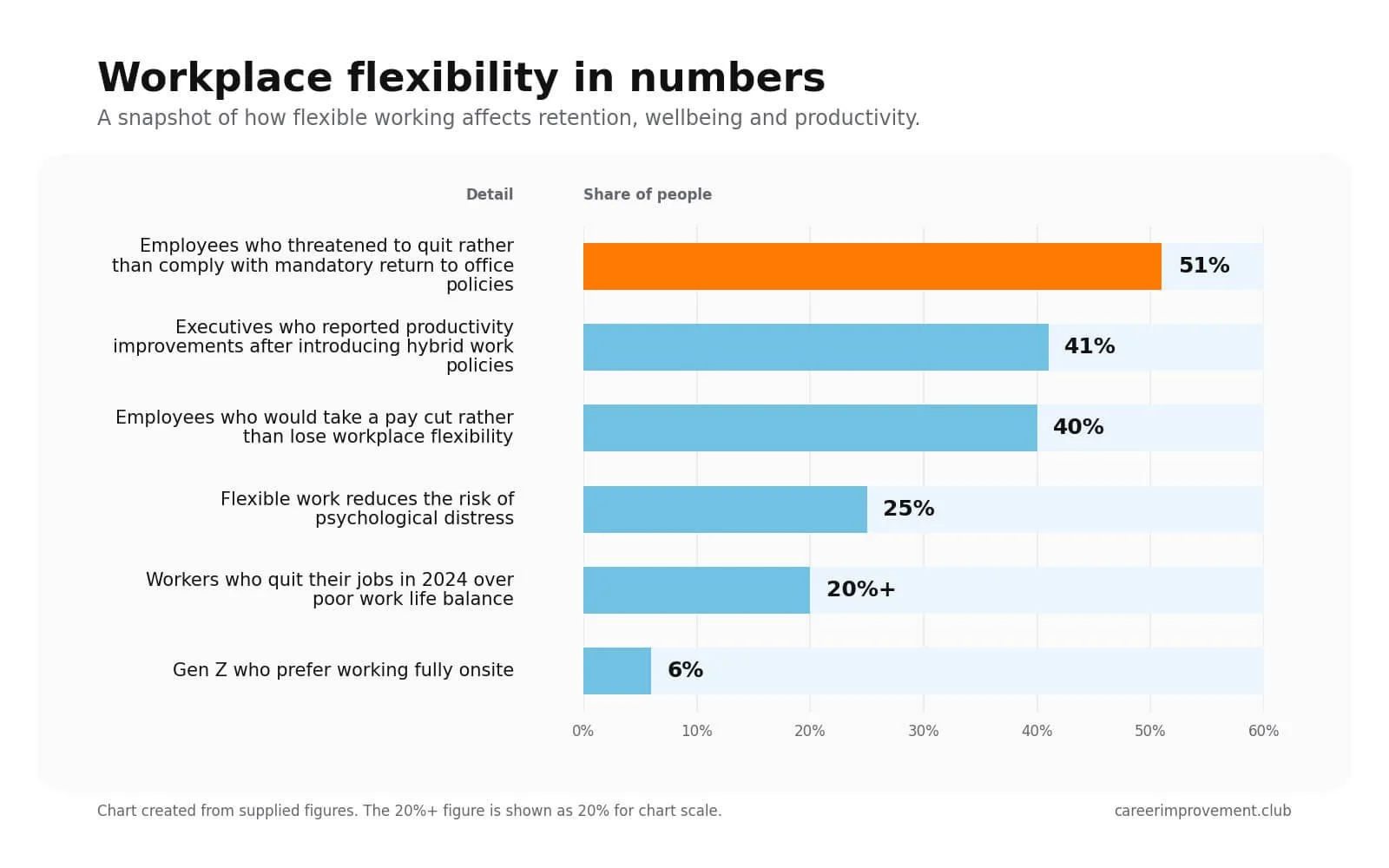
Workplace Flexibility in Numbers
Employees who would take a pay cut rather than lose workplace flexibility - 40%
Workers who quit their jobs in 2024 over poor work-life balance - 20%+
Executives who reported productivity improvements after introducing hybrid work policies - 41%
Flexible work reduces the risk of psychological distress - 25%
Employees who threatened to quit rather than comply with mandatory R-T-O policies - 51%
Gen Z who prefer working fully on-site - 6%
Flexibility Is No Longer Optional
If there is one thing the last few years have taught business owners and managers, it's that work is no longer tied to a place or schedule. It's tied to the most productive arrangement.
Flexibility isn't about being modern or following the trend. It's about being practical. And the results are clear enough to see.
The question now is, is your organisation willing to adapt before you lose all your good people?