

In today's fast-changing job market, securing a career that provides both stability and growth is a top priority. Industries are rapidly evolving due to technology, automation, and economic uncertainty. Consequently, experts pursue career paths providing enduring stability and room for growth.
Stability ensures consistent income and job security, while growth allows individuals to develop new skills and progress in their careers. Weighing both requires diligent research, self-assessment, and monitoring industry trends. Many high-demand fields today successfully combine these two elements, making them attractive for job seekers.
In this article, we’ll explore how to identify and pursue careers that deliver both stability and long-term professional growth.
QUICK ANSWER
To find a career that offers both stability and growth, look for work in sectors with consistent demand, clear progression routes and skills that remain valuable as the market changes. The strongest career paths usually combine job security, learning opportunities, transferable skills and long-term advancement potential.
To choose a stable career with room to grow:
Look for industries with steady long-term demand
Check whether the career has clear progression routes
Research salary growth, skills demand and future hiring trends
Compare education requirements against long-term rewards
Build transferable skills that work across different roles
Choose employers that invest in training and development
Avoid choosing a career based only on salary, passion or short-term trends
Look for Industries With Consistent Demand
Industries with consistent demand often provide greater job security during economic changes. Fields such as healthcare, education, technology, and essential services continue to require qualified professionals. Researching labor market trends can help identify sectors with steady hiring needs. Choosing a career in these industries may support long-term employment stability and growth.
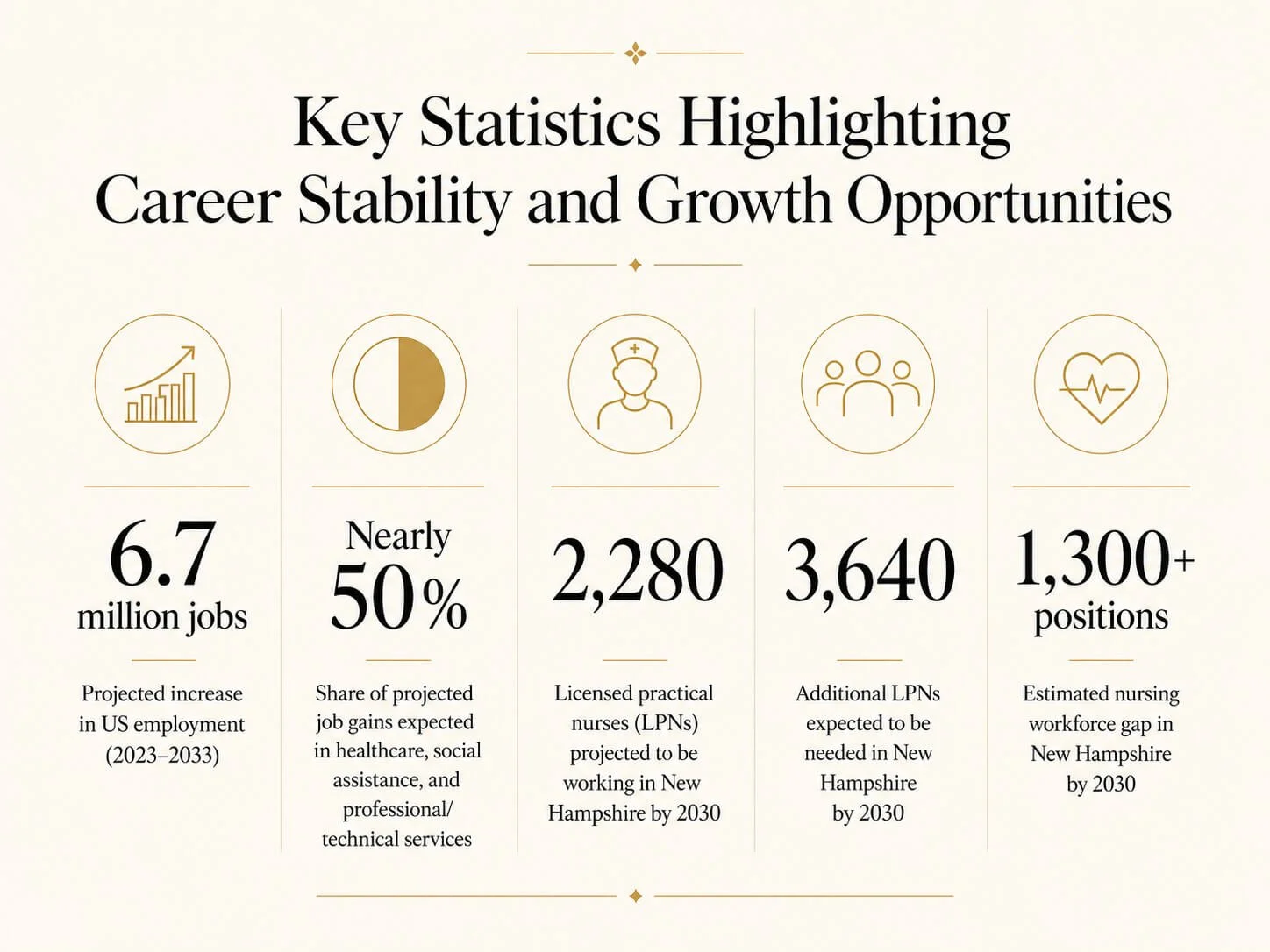
According to the US Bureau of Labor Statistics, employment is projected to increase by 6.7 million jobs between 2023 and 2033. Healthcare, social assistance, and professional services will drive nearly half of these expected gains. This trend highlights strong opportunities for careers in healthcare, technology, and related fields.
ACTIONABLE TIP
Before choosing a career path, research whether the industry has:
Consistent hiring demand
Clear skills shortages
Long-term social or economic need
Technology that supports the work rather than replacing it
Multiple entry points and progression routes
If a sector appears in several labour market reports, job boards and skills shortage discussions, it is usually worth exploring further.
Consider Careers With Clear Advancement Pathways
Careers with certifications and specialization opportunities support long-term professional growth. These pathways help workers develop expertise, increase responsibilities, and improve earning potential. Nursing, for instance, exemplifies this approach, offering steady demand alongside advancement opportunities in clinical specialties, leadership, education, and advanced practice roles.
Nursing offers clear advancement opportunities and strong long-term demand. For example, the NH Business Review reported strong demand for nursing professionals in New Hampshire. Although 2,280 licensed practical nurses are projected to be working by 2030, the state is expected to need 3,640 additional licensed nurses. This projected shortage of over 1,300 positions shows the field's stability and growth potential.
As a result, individuals looking to become RN in New Hampshire can enter a profession with strong long-term demand. They can also pursue management roles, specialized practice areas, and advanced nursing credentials as their careers progress.
Saint Joseph’s College of Maine emphasizes nursing’s value and the difference RNs make daily. Beginning a nursing career in New Hampshire offers opportunities for growth and service. Whether you stay or relocate, RN work rewards.
ADDITIONAL INSIGHT
A good career path should show you what the next few steps could look like. That does not mean you need to know your entire future, but you should be able to see possible routes forward.
For example, a career with growth potential may allow you to move into management, specialise in a technical area, gain professional certification, increase responsibility or shift into a related role later.
If a career has no obvious next step, it may offer short-term stability but limited long-term growth.
ACTIONABLE TIP
When researching a role, search for three versions of it:
Entry-level role
Mid-level role
Senior or specialist role
Then compare the job descriptions. Look at how the responsibilities, salary, qualifications and skills change at each stage. This gives you a clearer picture of whether the career can grow with you.
👉 Understanding your career path can be one of the hardest parts of the job search, the following career development plan will help you unlock what roles work for you.
Evaluate Education Requirements Against Long-Term Rewards
Some professions require additional training or degrees but offer greater job stability, earning potential, and advancement opportunities. Evaluating the return on educational investment can help individuals make informed decisions. A well-planned career path often provides lasting professional and financial rewards.
According to the Organisation for Economic Co-operation and Development (OECD), global crises and megatrends are reshaping workforce skills. The organization focuses on the growing importance of developing skills needed for 21st-century labor markets. These shifts make it essential to evaluate education requirements carefully.
ACTIONABLE TIP
Before investing in a course, certification or degree, ask:
Is this qualification commonly requested in job adverts?
Will it help me access better-paid or more stable roles?
Does it open up more than one career route?
Can I study while working?
How long will it take to earn back the cost through higher earnings or better opportunities?
Education can be valuable, but it should support a clear career outcome.
Prioritize Transferable Skills Over Job Titles
In today’s evolving job market, focusing on transferable skills over job titles is becoming increasingly important for professionals. Versatile soft skills like communication, leadership, and adaptability smoothly transfer across diverse career paths.
Unlike job titles, which may vary between organizations, transferable skills demonstrate a candidate’s true capability and long-term value. Employers are increasingly focusing on what individuals can do rather than just their previous positions.
This pivot helps professionals pursue wider career options and adapt to shifting industry demands. Continuously developing versatile skills boosts employability, increases career mobility, and strengthens competitiveness in evolving workplaces.
ADDITIONAL INSIGHT
Job titles can change quickly. Skills travel further.
A person with strong communication, leadership, digital confidence, problem-solving and project management skills can often move between sectors more easily than someone whose experience is tied to one narrow job title.
This is especially important in a changing job market. The more transferable your skills are, the more options you have if your industry shifts, your role changes or new opportunities appear.
ACTIONABLE TIP
Create a transferable skills list with three columns:
Skills I use now
Roles or industries where these skills are also useful
Evidence that proves I have used them well
This makes it easier to update your CV, prepare for interviews and explore new career routes.
👉 If your LinkedIn profile is out of date, this guide shares practical LinkedIn profile tips for job seekers.
Research Long-Term Industry Trends
Understanding future industry developments helps individuals make more informed career decisions. Changes in technology, demographics, and consumer behavior can significantly influence future job opportunities. Keeping up with these changes enables professionals to adapt to new roles and emerging workforce requirements. A forward-looking approach can support both career stability and long-term growth.
Rabih Fakhreddine, Founder and Group CEO of 7 Management, noted that developers increasingly seek strategic partners over traditional operators. He emphasized that hospitality is evolving into a critical infrastructure. This perspective focuses on the importance of researching long-term industry trends. Understanding industry shifts helps professionals align careers with future growth opportunities.
ADDITIONAL INSIGHT
A career can look attractive today but become less secure if the wider industry is moving in the wrong direction. That is why trend research matters.
Look beyond individual job adverts and ask what is driving demand. Is the sector growing because of demographics, regulation, technology, public need, climate change, infrastructure, healthcare demand or skills shortages?
The strongest career choices are often connected to long-term forces, not short-term hype.
ACTIONABLE TIP
Set a monthly habit to review:
Industry news
Job boards
Salary guides
Skills reports
Employer hiring patterns
LinkedIn posts from people in the sector
Over time, you will start to see which careers are genuinely growing and which are just getting temporary attention.
Choose Employers That Support Professional Development
Organizations that invest in training, mentorship, certifications, and continuing education help employees build valuable skills and remain competitive. These opportunities often result in higher job satisfaction, better performance, and stronger advancement potential for employees.
Professional development programs also demonstrate an employer’s commitment to employee growth and retention. When evaluating career options, it is important to consider whether a company provides clear pathways for learning and progression. Choosing an employer that prioritizes development can create a stronger foundation for both career stability and future growth.
👉 If you want to check whether a potential employer genuinely supports growth, this guide shares smart questions to ask in a job interview, including questions about development, culture and future prospects.
Frequently Asked Questions
Should I prioritize passion or job security?
Both passion and job security are important, but balance is key. Passion drives motivation and long-term satisfaction, while job security ensures financial stability. Ideally, choose a path where your interests align with stable or growing industries. This combination supports sustainable career success.
How do I know if a career is the right fit for my personality?
Careers thrive when they match your unique interests, strengths, and preferred working style. Consider how you respond to tasks, teamwork, and pressure. Internships, job shadowing, and assessments can help you evaluate compatibility. Self-reflection is essential in making the right choice.
What are the biggest mistakes people make when choosing a career?
One major mistake is choosing a career based only on salary or external pressure. Ignoring long-term growth and industry demand can also lead to dissatisfaction. Many people fail to research required skills or future trends. Careful planning helps avoid these common career mistakes.
What is the difference between a stable career and a growing career?
A stable career offers reliable demand, consistent employment opportunities and long-term security. A growing career offers progression, higher earning potential, new skills and future advancement. The best career paths usually offer both, giving you security now and room to develop later.
How can I tell if an industry has long-term demand?
Look for repeated evidence across job boards, labour market reports, salary guides and employer hiring trends. If multiple sources show demand, skills shortages or projected growth, the industry may offer stronger long-term prospects.
Is it worth changing career for better stability?
It can be, but only if the new path also fits your skills, interests and lifestyle. Stability alone may not be enough if the work feels unsuitable. Before changing direction, research the role properly, speak to people in the field and check what training or experience you may need.
Key Statistics Highlighting Career Stability and Growth Opportunities
Building a Future-Proof Career Path
Finding a career that offers both stability and growth requires careful planning and informed decision-making. Individuals must evaluate industry trends, required skills, and long-term opportunities before making choices. Balancing personal interests with job security can lead to more sustainable career satisfaction.
Employers that invest in employee development often provide stronger growth potential. Transferable skills and continuous learning also play a key role in career success. Ultimately, a thoughtful approach enables individuals to build a stable, rewarding, and successful long-term professional future.
👉 If you are ready to present yourself more professionally, browse our CV templates and job search tools to create a clearer, better structured application for your next career move.